Despite decades of technological and pharmacological innovation, the foundational execution of percutaneous coronary intervention (PCI) remains unchanged. Operators and cath lab teams still face occupational hazards from cumulative ionising radiation exposure and orthopaedic injury from wearing lead aprons. Robotic-assisted percutaneous coronary intervention (R-PCI) offers a compelling solution, allowing the interventional operator to sit in a radiation-shielded cockpit utilising a touchscreen and joysticks for independent control of the guide catheter, guidewire, and intracoronary devices. Manual vascular access, performance of diagnostic angiography, and guide catheter engagement are still required. Additionally, a bedside assistant is needed to load and exchange equipment into the robotic arm. Since the first-in-human study of R-PCI in 2011, subsequent observational studies have demonstrated high procedural success rates without significant safety concerns.1
In this issue of AsiaIntervention, Leung et al present the results of the Percutaneous coronary intervention using Assisted Robotic TechnologY (PARTY) trial, the first randomised clinical trial evaluating R-PCI.2 This investigator-initiated, open-label, single-centre Australian trial randomised 148 patients with symptomatic coronary artery disease and suitable anatomy 1:1 to either R-PCI (n=72) or manual percutaneous coronary intervention (M-PCI; n=76) between June 2023 and January 2025. R-PCI was performed using the CorPath GRX device (Siemens Healthineers) by trained operators after completing five proctored cases. Radial access was recommended, and standard best practices to minimise radiation exposure were employed. The primary endpoint was patient radiation exposure evaluated via an intention-to-treat (ITT) analysis. Secondary endpoints included radiation exposure to the operator, assistant, and nursing staff, as well as clinical success, defined as less than 30% residual stenosis without in-hospital major adverse cardiovascular events (MACE). Procedural success was defined as successful PCI completion without unplanned manual conversion. Additional secondary endpoints included total PCI procedure time, contrast volume, radiation parameters, safety outcomes, and operator workload across physical, mental, and temporal domains.
The study population was reflective of contemporary practice, with a median patient age of 63.2 years; 82.4% male, 35.1% with diabetes, and 77.7% presented with an acute coronary syndrome. The majority underwent transradial (89.9%), single-vessel PCI (90.5%), with most lesions characterised as ACC/AHA class B2 or C (R-PCI 89.7%, M-PCI 94.1%). Lesion characteristics were well balanced between groups. Patients in the M-PCI arm received a greater number of stents (1.8 vs 1.3; p<0.01) with a greater total stent length (34 mm vs 25 mm; p<0.01). They also had a higher rate of intravascular imaging utilisation (67.1% vs 31.9%; p<0.01).
The PARTY trial does not evaluate whether we should use R-PCI, but rather how the implementation of R-PCI impacts radiation exposure and workload. The trial did not meet its primary endpoint; there was no statistically significant difference in patient radiation exposure via the ITT analysis (R-PCI 230.7 μSv vs M-PCI 261.4 μSv; p=0.14). While the authors highlight a significant reduction in the as-treated analysis (218.5 μSv vs 264.7 μSv; p=0.03), the negative ITT finding must guide interpretation. This discrepancy is explained by seven R-PCI cases that required manual conversion, primarily early in the enrolment period, due to the inability to deliver equipment (n=3), irrecoverable guide disengagement (n=2), cassette malfunction (n=1), or a coronary artery perforation (n=1). Furthermore, the trial was prematurely terminated at 148 patients due to the manufacturer’s market removal of the device, though the authors note that a sample size of 150 still maintained greater than 90% power.
Overall, procedural success was achieved in 84.7% of R-PCI cases. Procedure times were comparable between groups (40 min vs 46 min; p=non-significant [NS]), though R-PCI significantly reduced contrast volume (75 mL vs 100 mL; p<0.01) and lowered operator workload across all domains. While operator radiation exposure was almost completely eliminated with R-PCI (R-PCI 0.1 μSv vs M-PCI 13.6 μSv; p<0.001), exposure to the bedside assistant nearly doubled (R-PCI 6.0 μSv vs M-PCI 3.4 μSv; p=0.02). This likely occurred because the assistant must stand closer to the radiation source to load equipment instead of the primary operator. If robotic technology is to achieve mainstream adoption, it must protect the entire cath lab team rather than benefiting the seated physician at the expense of the assistant. Widespread implementation will require optimised workflows or technological iterations to mitigate this shifted radiation burden.
The more than twofold higher use of intravascular imaging in the M-PCI arm is a confounder. The CorPath GRX platform is incompatible with rotational imaging devices, which likely restricted intravascular imaging use in the R-PCI arm. This may have prolonged procedural times and increased contrast volume in the M-PCI arm, biasing the comparison. The reductions in stent number and length seen with R-PCI might be explained by enhanced visualisation; the cockpit positions the operator closer to the fluoroscopy screens, potentially reducing geographical miss. However, it is also possible that the M-PCI group had more extensive disease treated because of the findings on intravascular imaging.
With regard to safety outcomes, there was no mortality observed at 30-day follow-up. Periprocedural myocardial infarction rates were comparable, occurring in 16.7% of R-PCI and 21.1% of M-PCI cases (p=NS). The single coronary artery perforation was the only serious procedural complication; it was treated with covered stent placement and deemed unrelated to the robot. In terms of efficiency, the average robotic setup time was just 2.5 minutes, demonstrating that R-PCI integration is feasible in daily clinical practice even in time-sensitive acute coronary syndrome scenarios.
The findings of the PARTY trial provide randomised validation for earlier observational data, demonstrating that R-PCI delivers comparable efficacy to M-PCI, significant radiation reduction for the operator, and a favourable safety profile.1 Our group previously demonstrated the safety and feasibility of R-PCI in complex lesions in the CORA-PCI study (n=108 R-PCI, n=226 M-PCI registry controls), reporting a 91.7% technical success rate and a low 0.93% MACE rate.3 Consistent with the PARTY trial, there were no differences in clinical success or fluoroscopy times, though procedure times were longer for low-complexity robotic cases, with no differences in stent metrics or contrast volume. Furthermore, MACE rates were comparable up to 12 months.4 Most recently, the prospective post-market, 31-centre PRECISION GRX registry demonstrated a 97.8% clinical success rate across diverse practices.5
While R-PCI undoubtedly has a role in the future of interventional cardiology, several technical, procedural, and clinical challenges must be addressed before it can be integrated into routine clinical practice. The PARTY trial was underpowered for major clinical endpoints, and despite comparable 30-day MACE, longer-term data are needed. R-PCI technology is not suitable for all lesion subsets, as it lacks compatibility with over-the-wire platforms or lesions requiring simultaneous balloons or stents, and manual conversion may be necessary even in patients with suitable anatomy. From an economic perspective, our prior work demonstrated that the total institutional cost of R-PCI is comparable to M-PCI, despite expected increases in direct supply costs from single-use robotic components.6 Beyond standard PCI, the feasibility of robotic assistance has been established in select chronic total occlusions and peripheral vascular interventions.
The most disruptive potential of this technology lies in telestenting, the ability to perform remote interventions over long distances for underserved or rural populations (Figure 1). With successful telerobotic PCI already demonstrated from 20 miles away7 and transatlantic proof-of-concept models established,8 the foundation has been laid. As R-PCI technology evolves, it has the potential to alleviate occupational hazards for interventional cardiologists while simultaneously making the environment safer for the entire cath lab team, reducing patient radiation exposure, and improving access to PCI care via telerobotics.
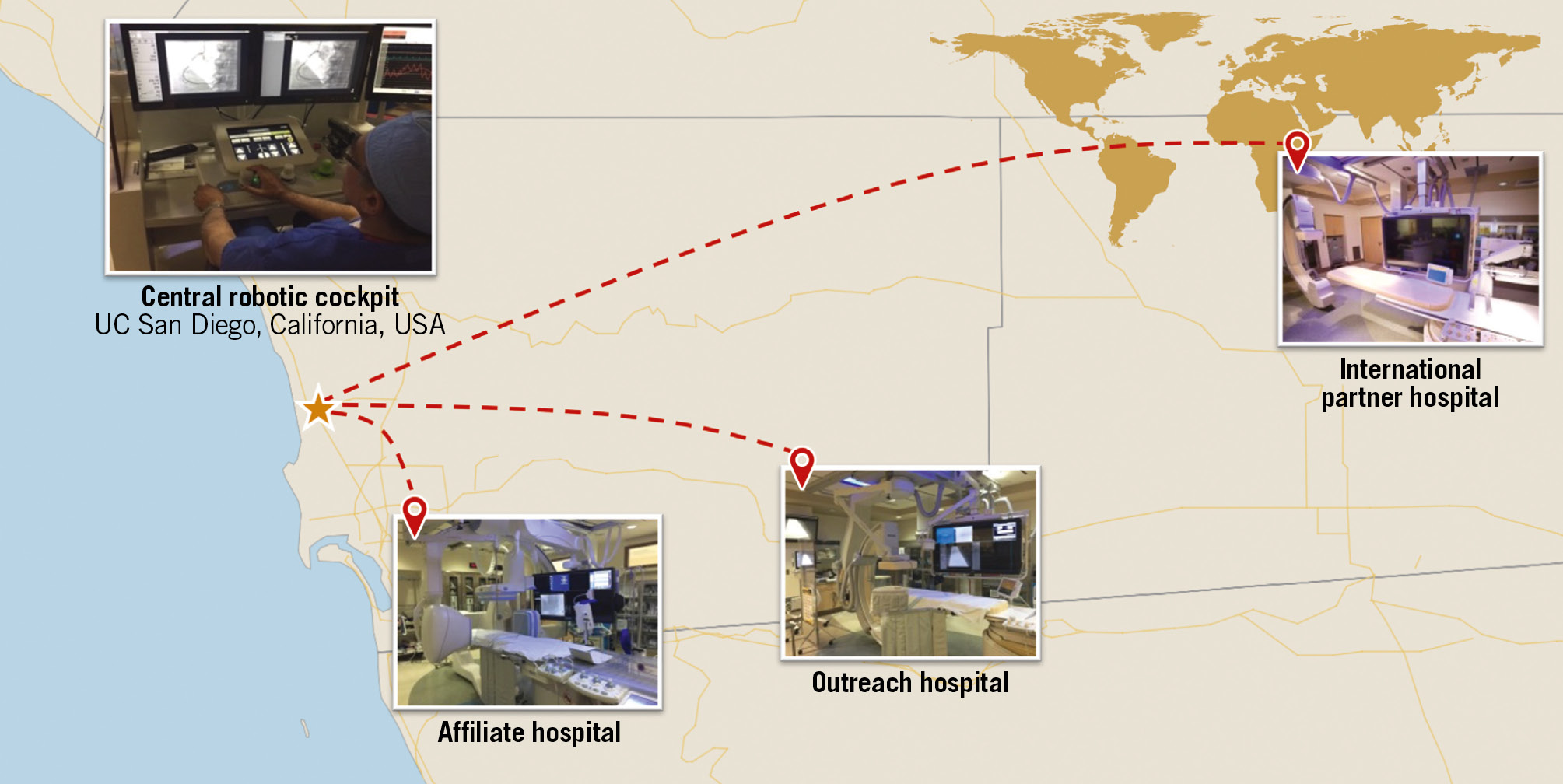
Figure 1. Conceptual design of a regional and international remote robotic PCI network. Within a single healthcare system, experienced high-volume operators could perform remote robotic PCI or assist during complex interventions at affiliate, outreach, or international partner hospitals. Implementation requires telecommunication capability to support real-time communication between centres with minimal delay. PCI: percutaneous coronary intervention
Conflict of interest statement
E. Mahmud served as the International Principal Investigator for the Precision GRX study. R. Sampath-Kumar has no conflicts of interest to declare.