Hypertension, known as the “silent killer”, affects 1.2 billion people globally and is a major cause of cardiovascular disease (CVD) and mortality, particularly in low- and middle-income countries (LMICs)12. Over the past 30 years, its prevalence has doubled, reaching 32% in females and 34% in males, with significant rates in LMICs123. In India, hypertension prevalence is 29.8%, varying between rural (27.6%) and urban (33.8%) areas4. Contributing factors include poor diet, high sodium intake, smoking, alcohol consumption, and physical inactivity5. Resistant hypertension (RH) is defined as a seated office blood pressure (BP) >140/90 mmHg despite treatment with three or more antihypertensive medications at optimal or maximally tolerated doses, including a diuretic6. RH affects 12-18% of hypertensive individuals7. RH is linked to increased risks of CVD, end-stage renal disease (ESRD), and mortality, exacerbated by factors like older age, obesity, Black race, male sex, diabetes, ischaemic heart disease, stroke, and chronic kidney disease (CKD)89. Diagnosis is complicated by pseudoresistance and secondary hypertension due to kidney diseases, endocrine disorders, renovascular hypertension, obesity, and sleep apnoea, alongside medication non-adherence and non-steroidal anti-inflammatory drugs worsening hypertension management. Patients with RH have a 47% higher risk of cardiovascular (CV) death, along with increased adverse events such as myocardial infarction, stroke, congestive heart failure, and chronic kidney disease, compared with those with non-resistant hypertension10.
Factors contributing to these outcomes include ineffective drug combinations and significant medication non-adherence (53% in patients using ≥4 drugs)11. Identifying frailty and recognising the challenges it presents in adhering to treatment can help target elderly patients with a poorer prognosis or those at risk of complications from untreated hypertension12. However, management of hypertension presents significant challenges, including adverse effects observed with antihypertensive medications, especially at high doses. Addition of antihypertensive drugs beyond the 3rd or 4th drug escalates the issues of side effects and non-adherence513. Therefore, there is a critical need for alternative treatments, such as adjunctive procedural options, to improve patient outcomes and adherence14.
However, the implementation of international guidelines and triage tools in the Indian context faces distinct challenges. These include a high prevalence of metabolic syndrome and early-onset hypertension in South Asian populations, significant economic barriers to lifelong multidrug therapy, limited access to specialised hypertension centres and ambulatory blood pressure monitoring (ABPM), and a heterogeneous distribution of procedural expertise. Therefore, a direct translation of global algorithms may be suboptimal, creating a need for a tailored approach.
Device-based interventions like renal denervation (RDN) offer a safe, effective, and durable method to lower blood pressure in patients with uncontrolled hypertension, either alone or in conjunction with medications5. RDN employs catheter-based techniques to ablate sympathetic nervous fibres along renal arteries, addressing a major element of the complex pathophysiology of hypertension15. This approach targets sympathetic dysregulation, showing its efficacy in reducing BP and mitigating organ-specific damage caused by chronic sympathetic overactivity16. RDN modulates this pathway in various experimental models by interrupting renal afferent nerve signalling, supporting its potential as an effective therapeutic strategy17. It is important to acknowledge, however, that the real-world response to RDN can be variable, and its cost-effectiveness and widespread feasibility within the infrastructure of low- and middle-income countries like India require careful consideration.
The primary objective of this article is to develop a pragmatic “RDN triage tool” specifically adapted for the Indian and broader South Asian context. This tool is intended to address local challenges such as socioeconomic constraints, healthcare infrastructure limitations, and region-specific patient phenotypes. The development of this tool is informed by a systematic review of the evidence and formal expert consensus, with the aim of providing a practical framework for patient selection that bridges the gap between international evidence and local clinical practice.
A Central illustration summarising the clinical problem of resistant hypertension, the contextual challenges in the Indian healthcare setting, the consensus-driven methodology, and the proposed RDN triage framework is provided.
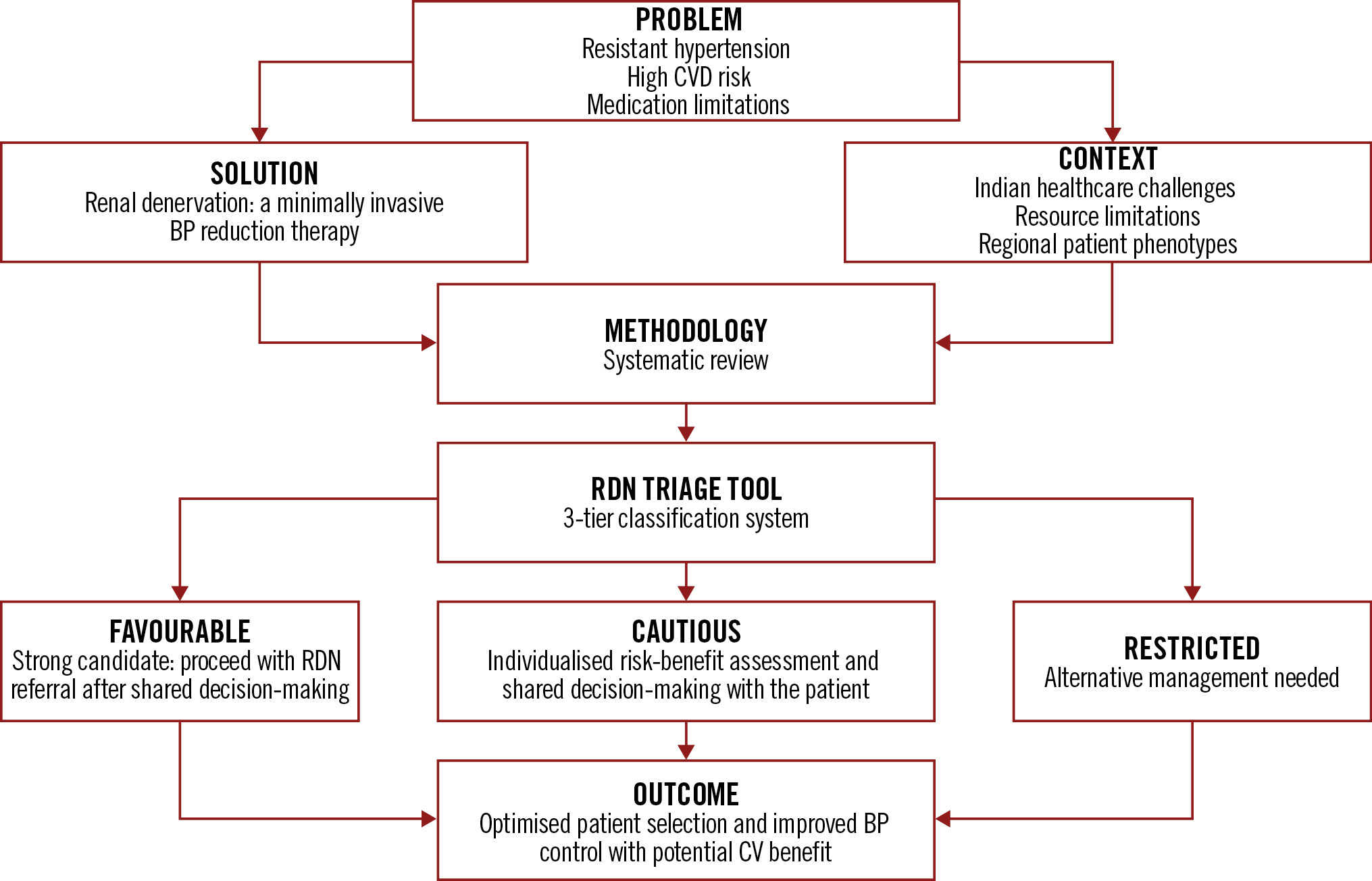
Central illustration. Development of the renal denervation triage tool for the management of resistant hypertension. Conceptual framework illustrating the development of a renal denervation (RDN) triage tool. The clinical problem is outlined, including resistant hypertension with high cardiovascular risk, contextual challenges within the Indian healthcare system, and the consensus-based methodology using systematic review. This approach leads to a 3-tier RDN classification (favourable, cautious, or restricted) aimed at optimising patient selection, improving blood pressure control, and enhancing cardiovascular outcomes. BP: blood pressure; CV: cardiovascular; CVD: cardiovascular disease
Methods
Systematic literature review
A systematic literature review was conducted following the Preferred Reporting Items for Systematic Reviews and Meta-Analyses (PRISMA) guidelines (https://www.prisma-statement.org/prisma-2020-checklist) to synthesise the evidence on the efficacy, safety, and patient selection criteria for RDN in RH.
Data sources and search strategy: a comprehensive search of electronic databases (PubMed, Cochrane Central Register of Controlled Trials, Embase, and Scopus) was performed for articles published from January 2010 to December 2023. The search strategy utilised a combination of medical subject headings (MeSH) terms and keywords, including: “renal denervation”, “resistant hypertension”, “uncontrolled hypertension”, “catheter-based ablation”, “SYMPLICITY”, “SPYRAL”, “radiofrequency ablation”, and “ultrasound ablation”.
Eligibility criteria
Inclusion criteria: randomised controlled trials (RCTs), non-randomised interventional studies, large observational registries, and meta-analyses focusing on RDN in adult human patients with resistant or uncontrolled hypertension.
Exclusion criteria: animal studies, editorials, conference abstracts without full-text availability, non-English language articles, and studies focusing on non-resistant hypertension or other indications for RDN.
Study selection and data extraction: the retrieved records were screened independently by two authors based on their title and abstract, followed by a full-text review of potentially eligible studies. Any discrepancies were resolved through consensus or consultation with a third author. Data from the included studies were extracted using a standardised form, capturing details on study design, patient demographics, RDN technology and technique, BP outcomes (office and ambulatory), safety endpoints, and follow-up duration.
Quality assessment: the methodological quality of the included RCTs was assessed using the Cochrane Risk of Bias tool (RoB 2). Observational studies were appraised using the Newcastle-Ottawa Scale.
Development of the RDN triage tool
A multidisciplinary panel of Indian experts from cardiology, nephrology, endocrinology, and internal medicine was convened. The panel reviewed and discussed the available scientific literature and current clinical practices relevant to the management of hypertension in the Indian setting. Based on the synthesised evidence from the literature and insights from expert discussions, an initial draft of the triage tool was developed.
The draft triage tool was reviewed during multidisciplinary advisory board discussions. Panel members provided their expert opinions on the clinical relevance, practicality, and applicability of each component of the tool within the Indian healthcare context. Feedback from the panel was incorporated through iterative discussions and revisions until a broad agreement was achieved among the experts.
The final recommendations included within the triage tool were informed by the available published evidence and established clinical guidelines from major cardiology societies. These recommendations were adapted to reflect the clinical realities and practice patterns relevant to the Indian context.
Evidence review
Clinical implications of RDN
The two most widely studied modes of RDN are radiofrequency RDN (RF-RDN) and ultrasound RDN (uRDN). These are performed through the femoral artery with selective renal angiography15. Early clinical trials of RDN have effectively and safely lowered BP in patients with RH18. In the second generation of sham-controlled trials, RDN reduced ambulatory and office BP in patients in the presence, and also in the absence, of antihypertensive medications19.
The SPYRAL HTN-ON MED study found that the RDN group had a significant decrease in 24-hour systolic blood pressure (SBP) of 18.7 mmHg at 36 months compared to the sham control group’s 8.6 mmHg decrease, a difference of 10.0 mmHg, which was statistically significant. Safety events were rare, with no renal artery stenosis or reintervention20. Meta-analyses of 5,769 patients from 50 RDN studies revealed a low incidence of renal artery stenosis or dissection (0.45%), supporting RDN’s efficacy and safety in treating hypertension21.
The Global SYMPLICITY Registry (GSR) DEFINE investigated 2,746 patients, with 18% on 0-3 and 82% on ≥4 antihypertensive medications. At 36 months, office SBP decreased by 19.0±28.3 mmHg for the 0-3 medication classes group and 16.2±28.6 mmHg for the ≥4 medication classes group. Furthermore, the 24-hour mean SBP significantly decreased across groups. BP reduction was similar regardless of the medication regimen, with most patients either reducing or maintaining their number of medications. The study concluded that radiofrequency RDN safely reduced BP up to 36 months, making it a safe and effective adjunctive therapy14.
Furthermore, in the analysis of the GSR-Taiwan, the first real-world registry of RDN in Taiwan, the safety and efficacy of RDN in 26 Taiwanese patients with uncontrolled hypertension using the Symplicity Flex and Symplicity Spyral catheters (both Medtronic) were evaluated. Sustained office BP reductions were observed for up to 3 years in the Flex group (29.7±25.9 mmHg) and up to 2 years in the Spyral group (42.4±10.7 mmHg; both p<0.05). The safety profiles remained consistent regardless of the RDN device used or the number of lesions to which they were applied22. Likewise, early BP-lowering effects were notable, consistent with the findings from previous trials like SYMPLICITY HTN-2, which achieved significant office-based BP reductions of 32/12 mmHg (±standard deviation 23/11) at 6 months post-RDN, with 84% of patients achieving a ≥10 mmHg SBP reduction compared to controls (p<0.0001)23, and SPYRAL HTN-ON MED, which showed a 18.7 mmHg decrease in ambulatory SBP at 36 months post-RDN, compared to 8.6 mmHg in sham controls (p=0.0039)20. Subanalyses from the Global SYMPLICITY Registry further underscored substantial and sustained BP reductions in Korean and Taiwanese subpopulations compared with Caucasian patients. These findings support the efficacy and safety of RDN as a therapeutic option for RH, warranting continued exploration and strategic implementation in diverse patient populations23.
Guideline positioning of RDN
Due to advancements in clinical trials and promising outcomes, the European Society of Cardiology (ESC) Council on Hypertension, in collaboration with the European Association of Percutaneous Cardiovascular Interventions6, updated their guidelines in 2024 to endorse RDN as an adjunct treatment for uncontrolled RH, supported by AHA 2024 consensus statements as well24. These guidelines apply to adult patients with uncontrolled or RH, particularly those who are on a combination of 3 blood pressure-lowering medications (including a thiazide or thiazide-like diuretic) and have not achieved control despite lifestyle changes and optimal pharmacological interventions. It also includes individuals who are unable to tolerate long-term antihypertensive medications or who express a desire to pursue renal denervation following a shared discussion of risks and benefits, as well as a multidisciplinary evaluation6. The 2023 European Society of Hypertension guidelines suggest RDN for patients with an estimated glomerular filtration rate (eGFR) >40 mL/min/1.73 m2 who have uncontrolled BP despite combination therapy, drug-related side effects, or true RH (Class II, Level of Evidence B)25. Meanwhile, the Asia Renal Denervation Consortium (ARDeC) convened to discuss regional perspectives. It highlighted RDN’s efficacy and safety in Asian populations, supported by trials such as SYMPLICITY HTN-Japan and the Global SYMPLICITY Registry26. This underscores RDN as a viable initial or adjunct therapy in device-based hypertension management252627. Defining the ideal candidate for RDN involves balancing the potential risks and benefits while prioritising patients with the greatest clinical need. Therefore, shared decision-making between the clinician and patient, incorporating a careful assessment of risks and benefits, is essential in determining appropriate treatment options15.
Defining the ideal candidate for RDN
Components of the RDN triage tool
A panel of experts in India convened to develop a comprehensive approach for patient selection in RDN therapy for RH. The “RDN triage tool” systematically categorises patient characteristics – demographics, blood pressure control, renal function, and cardiac status – to aid in therapy prioritisation. To guide clinical decision-making, this tool classifies patients into three distinct categories – “favourable indication”, “cautious indication”, and “restricted indication” – based on their clinical profile (Table 1, Figure 1).
Based on clinical evidence and expert recommendations, RDN therapy is strongly recommended for patients aged 18-75 years with an SBP >160 mmHg despite ≥3 antihypertensive drugs or drug intolerance, eGFR >40 mL/min/1.73 m2, and a history or high risk of atherosclerotic cardiovascular disease (ASCVD), caused by atherosclerosis, including myocardial infarction, stroke, and peripheral artery disease, heart failure, atrial fibrillation, or stroke. Renal denervation therapy should be used with caution in patients with a recent renal stent and untreated secondary hypertension (Table 1).
Table 1. The RDN triage tool/ergonomic decision-making tool.
| Phenotype | Favourable indication | Cautious indication | Restricted indication |
|---|---|---|---|
| Demography (age) | 18 to 75 years | >75 years without frailty | >75 years with frailty |
| BP control | SBP >160 mmHg; ≥3 drugs/repeated episodes of intolerance to antihypertensive drugs; >2 episodes of hospitalisation due to manifestation of HTN | SBP >140-160 mmHg; 3 drugs/occasional episodes of intolerance to antihypertensive drugs | Secondary hypertension* |
| Renal status | eGFR >40 mL/min/1.73 m² | eGFR <40 mL/min/1.73 m²; history of renal stenting (limited clinical data) | Abnormal renal arteries |
| Cardiac status | History of established ASCVD; high risk of ASCVD; heart failure; AF; stroke; CAD | History of ACS in the past 6 months; systemic vasculitis | End-stage heart failure |
| Favourable indication: a patient profile in this category, supported by clinical evidence, indicates that a referral for RDN should be prioritised. Cautious indication: profiles in this category necessitate a cautious approach, where the decision for RDN must be individualised after a shared risk-benefit discussion with the patient. *Causes of secondary hypertension: diabetic nephropathy, polycystic kidney disease, glomerular disease, renovascular hypertension, Cushing syndrome, aldosteronism, phaeochromocytoma, hypothyroidism, hyperthyroidism, hyperparathyroidism, coarctation of the aorta, sleep apnoea, obesity, pregnancy, medications (analgesics, hormonal contraceptives, antidepressants, and immunosuppressants) and supplements. ACS: acute coronary syndrome; AF: atrial fibrillation; ASCVD: atherosclerotic cardiovascular disease; BP: blood pressure; CAD: coronary artery disease; eGFR: estimated glomerular filtration rate; HTN: hypertension; RDN: renal denervation; SBP: systolic blood pressure | |||
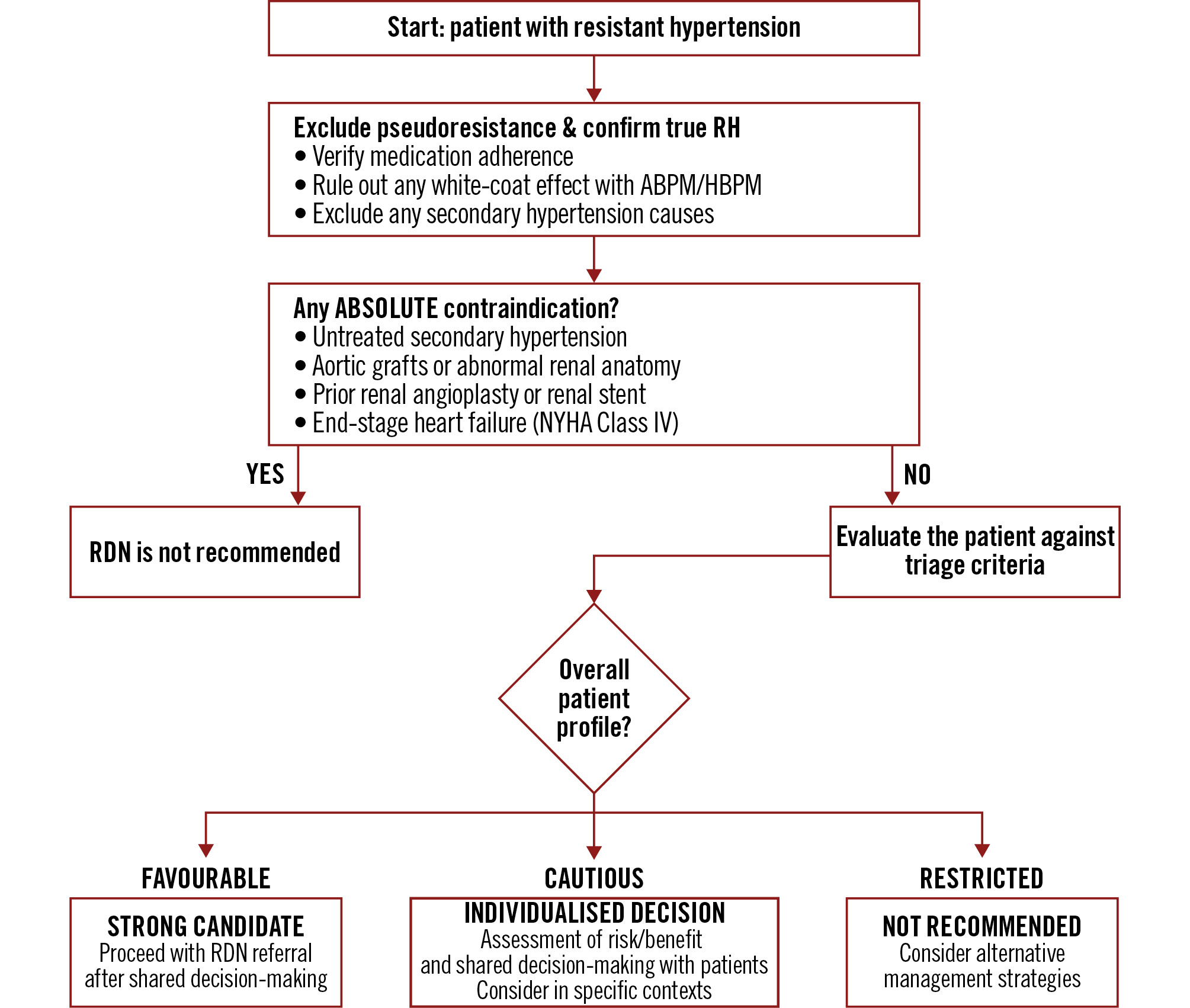
Figure 1. Visual algorithm for the RDN triage tool. ABPM: ambulatory blood pressure monitoring; eGFR: estimated glomerular filtration rate; HBPM: home blood pressure monitoring; NYHA: New York Heart Association; RDN: renal denervation; RH: resistant hypertension
Age and RDN outcomes
RDN has shown significant and sustained BP reductions across various age groups. In the GSR study, in which patients had a mean age of 59.1 years, the Symplicity Flex catheter group achieved sustained office BP reductions of 29.7 mmHg at 3 years, and the Symplicity Spyral catheter group achieved a 42.4 mmHg reduction at 2 years, with no significant changes in heart rate or medication classes28. The SYMPLICITY HTN-3 trial (mean patient age 57.9 years) reported an SBP reduction of 26.4 mmHg at 36 months in the RDN group versus 5.7 mmHg in the sham group, confirming the long-term safety of RDN28. The SPYRAL HTN-ON MED study (mean age in the mid-50s) found a significant ambulatory SBP reduction of 18.7 mmHg at 36 months, independent of medications, with no major safety issues20. The Global SYMPLICITY Registry DEFINE study confirmed BP reductions (19.0 mmHg in the 0-3 medication classes, 16.2 mmHg in the ≥4 medication classes) and low cardiovascular events14. These findings underscore RDN’s efficacy and safety in achieving sustained BP reductions across different age groups and medication regimens.
Baseline BP and RDN outcomes
Studies, such as those by Rohla et al, indicate that higher baseline SBP correlates with greater reductions post-RDN; for instance, patients in the highest quartile saw a significant decrease of 13.56 mmHg at 6 months (p<0.01)27. BP response to RDN is likely to be higher in cases of severe hypertension, due to heightened sympathetic tone29. Studies have suggested using baseline SBP and nighttime variability as indicators of RDN efficacy, which reflect sympathetic nervous system involvement in hypertension2930.
Renal function and RDN outcomes
In 2012, Hering et al reported a pilot study showing that RDN reduced SBP by approximately 30 mmHg at 1, 3, 6, and 12 months in patients with hypertension and renal dysfunction (eGFR 15-45 mL/min/1.73 m2), with stable renal function31. Subsequent case reports and series have demonstrated RDN’s efficacy and safety in patients with end-stage renal disease (eGFR <15 mL/min/1.73 m2)3233. In patients with mild-to-moderate renal dysfunction, Ott et al demonstrated that RDN lowered BP and slowed the decline in renal function34. Specifically, RDN stabilised the annual decline in eGFR, which was previously 3.5 mL/min/1.73 m2 over 60 months prior to RDN, with no change observed during the 24 months after RDN35. Moreover, data from the Global SYMPLICITY Registry showed consistent reductions in 24-hour ambulatory SBP and diastolic BP at 36-month follow-up, irrespective of baseline renal function. RDN achieves sustained BP reductions without adverse renal effects36, aligning with AHA guidelines25.
Impact of RDN on CV risk reduction
The GSR highlights radiofrequency RDN’s efficacy in reducing major adverse CV events among high-risk hypertensive patients; those on 0-3 and ≥4 antihypertensive medications saw significant office SBP reductions of 19.0±28.3 mmHg and 16.2±28.6 mmHg over 36 months, respectively (p<0.0001 for both). Additionally, the 24-hour mean systolic BP decreased by 10.7±19.7 mmHg and 8.9±20.5 mmHg (p<0.0001 for both). The reduction in 24-hour systolic BP at 3 years was 8.9±20.1 mmHg for the overall cohort, with high-risk subgroups showing reductions: 10.4±21.0 mmHg for resistant hypertension, 8.7±17.4 mmHg in patients aged ≥65 years, 10.2±17.9 mmHg for diabetes, 8.6±18.7 mmHg for isolated systolic hypertension, 10.1±20.3 mmHg for chronic kidney disease, and 10.0±19.1 mmHg for atrial fibrillation (all p<0.0001)14.
RF-RDN reduces major adverse CV events by nearly one-third over 3 years in resistant hypertension patients on multiple medications, as shown in real-world registry data30. The number needed to treat (NNT) was 32 for the overall cohort, with lower values observed in high-risk subgroups: 21 for resistant hypertension, 30 for type II diabetes mellitus, 28 for chronic kidney disease, and 27 for high atherosclerotic cardiovascular disease risk37.
These findings support renal denervation’s efficacy in high-risk populations, consistent with US and European recommendations. Studies indicate that pre-RDN BP levels reliably predict treatment outcomes in RH, with patients in the highest quartile experiencing a significant decrease of 13.56 mmHg at 6 months (p<0.01)37.
These findings underscore RDN’s potential for long-term BP reductions and improved cardiovascular outcomes, confirming its role as a safe and effective adjunctive therapy in managing hypertension, as recommended by the AHA and ESC1924.
Future perspectives
Despite the robust efficacy demonstrated in trials, it is crucial to acknowledge the heterogeneity in individual BP response to RDN. A proportion of patients are non-responders, and the predictors of response are still being elucidated. In India, significant barriers remain, including the high upfront costs of the procedure and catheter-based technologies, the need for specialised interventional expertise, which is currently concentrated in tertiary care centres, and the requirement for long-term follow-up. A formal cost-effectiveness analysis in the Indian healthcare system is urgently needed.
While the present RDN triage tool provides a structured, consensus-based framework for patient selection, its current formulation is a foundational step rather than a definitive endpoint. The true clinical utility of any decision-support tool lies in its validation and successful implementation in real-world settings. As this tool is consensus based, it has not yet undergone prospective validation to assess its impact on clinical decision-making, patient outcomes, or procedural success rates. To bridge this gap, future work must focus on integrating the tool into clinical practice. A prospective multicentre registry could be developed to validate the proposed triage tool in real-world clinical settings. Such a study would evaluate its ability to identify appropriate candidates accurately, predict BP response to RDN, and assess its effect on long-term adherence and cardiovascular outcomes. Furthermore, implementation science principles should be employed to understand the barriers and facilitators to the tool’s adoption across diverse healthcare settings in India, from tertiary care centres to larger secondary care hospitals.
Conclusions
This article underscores the profound impact of hypertension, especially in low- and middle-income countries, and the complexities in managing RH compounded by comorbidities. RDN has emerged as a promising adjunct therapy, supported by robust trial evidence from studies such as SPYRAL HTN-ON MED, and GSR – demonstrating sustained blood pressure reductions. The development of the RDN triage tool for clinical decision-making highlights the importance of precise patient selection and a comprehensive understanding of RDN therapy. These advancements affirm RDN’s efficacy and safety, underscoring its pivotal role in improving cardiovascular outcomes in RH management.
Funding
The multidisciplinary expert group meeting was supported by Medtronic, India.AcknowledgmentsThe authors acknowledge Shital Kolhe for assistance with medical writing and manuscript development.
Conflict of interest statement
The authors have no conflicts of interest to declare.