Endovascular treatment (EVT) for a superficial femoral artery (SFA) chronic total occlusion (CTO) remains challenging, particularly in long or calcified lesions1. Retrograde recanalisation techniques have improved success rates2, but conventional wire externalisation often necessitates extensive subintimal tracking of the retrograde guidewire to reach the antegrade guiding catheter. Here, we describe a novel technique in which a direct intraluminal rendezvous is achieved within the wire lumen of an intravascular ultrasound (IVUS) catheter positioned inside the CTO segment, allowing for safe and efficient wire externalisation.
An 84-year-old male with lifestyle-limiting claudication was referred for diagnostic evaluation and possible EVT.Angiography revealed a long-segment occlusion extending from the proximal SFA to the distal adductor canal. Initial antegrade 0.014” guidewire (ASAHI Gladius [ASAHI INTECC]) attempts resulted in subintimal tracking, making true lumen crossing unsuccessful. A retrograde approach was then performed via an anterolateral distal popliteal artery puncture under angiographic guidance3. A 0.014” guidewire (Astato XS 9-12, [ASAHI INTECC]) with a microcatheter (ICHIBANYARI PAD2 [KANEKA MEDIX CORP]) was retrogradely advanced through an intraplaque course, successfully crossing the CTO segment. To avoid advancing the retrograde guidewire to the guiding catheter, an IVUS catheter (Eagle Eye Platinum ST [Philips]) was introduced from antegrade into the occluded segment. The antegrade guidewire, preloaded inside the IVUS catheter, was briefly withdrawn to open the wire lumen. Rotational fluoroscopy was used to confirm coaxial alignment between the retrograde microcatheter and the IVUS catheter. Under real-time IVUS guidance, the retrograde 0.014” guidewire (CROSSLEAD Penetration [ASAHI INTECC]) was advanced directly into the IVUS catheter (Figure 1A, Figure 1B, Moving image 1). The wire tip disappeared from the IVUS image, indicating successful entry into the catheter’s wire lumen (Figure 1C, Figure 1D). Wire externalisation was then achieved via the antegrade guiding catheter (5.5 Fr GOGO [Medikit]) without the use of a snaring device. The exit port of the IVUS catheter was positioned within the guiding catheter, allowing the retrograde wire to be externalised through the antegrade system.
This case illustrates a novel rendezvous strategy in which the retrograde guidewire is directly captured within the wire lumen of an antegrade IVUS catheter positioned in the occluded segment of the SFA. Although peripheral SFA CTOs often require larger and stiffer guidewires, we initially selected a 0.014” guidewire to enable precise IVUS-guided intraluminal tracking and to anticipate a controlled intraluminal rendezvous within the IVUS catheter. The use of real-time intravascular imaging allowed visualisation of the guidewire entering the catheter lumen. The disappearance of the guidewire from the IVUS image (Figure 1C, Figure 1D) served as confirmation of a successful rendezvous. This method enables precise, controlled wire capture and avoids aggressive retrograde wire advancement that is often required in conventional pull-through techniques. Rotational angiography to confirm coaxial catheter alignment enhances reproducibility and safety. By minimising subintimal tracking and mechanical vessel stress, this approach potentially reduces complications such as vessel dissection or perforation45. Moreover, the technique is feasible using standard 0.014”-compatible guidewires and IVUS systems, making it broadly applicable without the need for dedicated re-entry devices. This approach represents a paradigm shift in peripheral CTO intervention by transforming the IVUS catheter from a diagnostic tool into an active conduit for wire externalisation. Direct intraluminal rendezvous into the wire lumen of an intravascular ultrasound catheter enabled safe, fast, and controlled wire externalisation during retrograde recanalisation of an SFA CTO. This technique may provide a valuable and reproducible strategy for complex endovascular procedures.
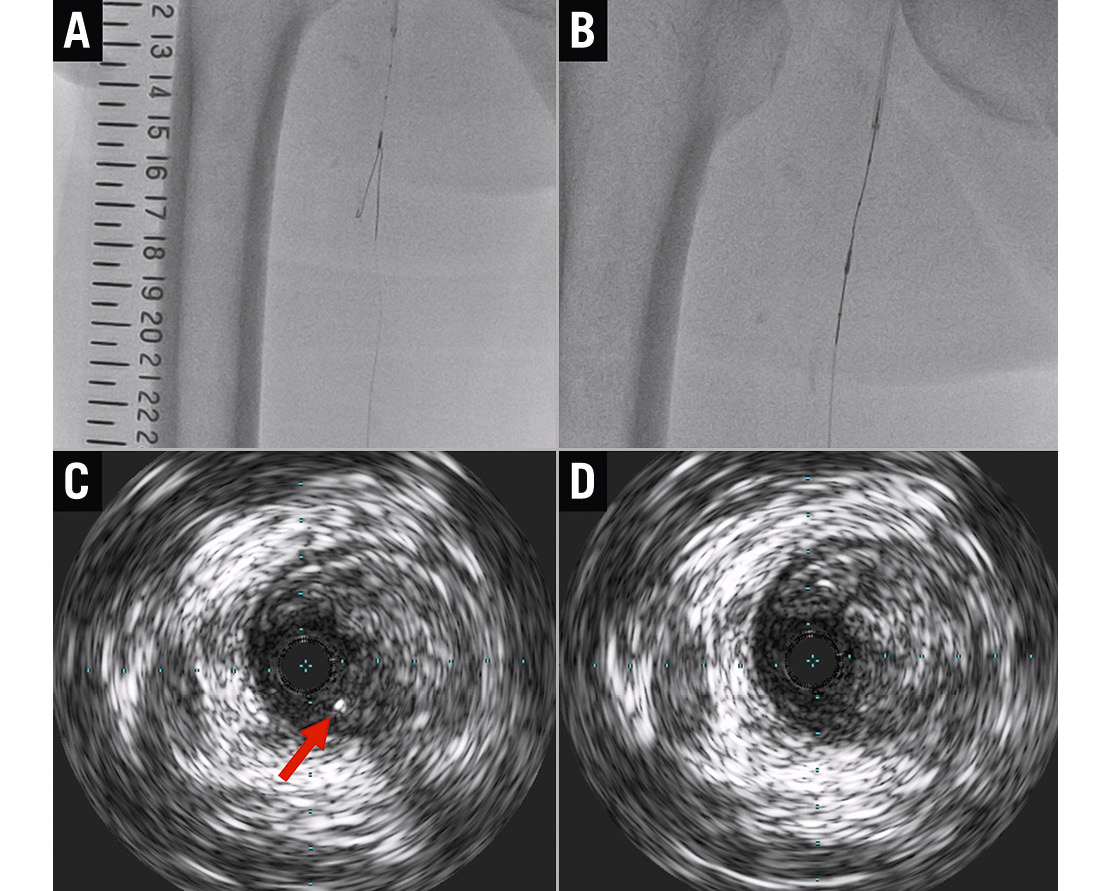
Figure 1. Intraluminal rendezvous imaging. A,B) Retrograde guidewire crossing and direct rendezvous into the wire lumen of the antegrade intravascular ultrasound (IVUS) catheter under real-time IVUS and (C,D) under fluoroscopic guidance. The red arrow indicates the guidewire.
Acknowledgements
The authors thank the staff of the Hokkaido Cardiovascular Hospital Catheterization Laboratory and the patient for consenting to the publication of this case.
Conflict of interest statement
The authors have no conflicts of interest to declare.