A few months ago, a manuscript came to a well-known journal and was sent to me for a review. The article was multicentric research on complex bifurcations and included a model describing the associated hydrodynamics which were correlated with the short- and intermediate-term results in a series of patients. The text of the article was flawless with very neat figures and graphs. Yet the CTRI number, when entered on the website, was non-existent. On checking a few references, they were out of place in the text and, once again, not correct. This led me to a diligent search on the hydrodynamics – I even involved a hydraulics expert – who found no correlation with the author’s hypothesis. I therefore concluded that it was completely a ghost manuscript – crafted end-to-end by generative artificial intelligence (AI) and sent it back to the journal with my comments.
Across biomedical publications, these imaginary and fabricated articles are an increasing presence. Large language models (LLMs) can synthesise statistical datasets, construct very complex-looking angiographic descriptions and then show innovatively fraudulent solutions in seconds at the click of a button. For us at AsiaIntervention – a journal dedicated to advancing high-calibre percutaneous coronary and structural interventions across the Asia-Pacific region – this technological shift presents an unprecedented challenge and puts us at a crossroads. It makes us look at each manuscript with an eye of suspicion. Even our proofreaders have been instructed to look at every page, especially the references, very carefully, and to verify their existence and relevance.
The use of AI for scientific writing is not inherently malicious; it exists on a spectrum of utility and risk. The advantages include its assistance to authors in summarising the massive available literature, it helps to develop new ideas by improving their narration, and it can identify some hitherto unreported findings. Authors from non-English speaking regions find it very useful in creating smooth, flowing text which helps the reviewer to concentrate on the science rather than getting embroiled in the linguistics. The disadvantages are that when it comes to analysing the results, AI often uses generative models of probabilities, not true verifications. The references and citations are often generated out of thin air, termed as “hallucinations”. These shortcuts often lead to the author being suspected of fudging the results. The author maintains responsibility for the originality, accuracy, integrity, and clinical relevance of the work, whether generated by AI or not. Confidential patient information and unpublished or proprietary data should not be entered into AI systems without appropriate safeguards. Authors should therefore disclose the use of AI when required by journal policy and should regard AI as an assistive, rather than an authorship, tool. Authors are fully accountable for every citation and all data put in their manuscript. A fictitious reference is treated as scientific misconduct, regardless of whether a human or a machine generated it. Likewise, AI-generated manuscripts cannot sign conflict-of-interest forms, guarantee data integrity, or face legal accountability. Authorship must therefore remain strictly human.
AI can similarly support reviewers by helping identify methodological weaknesses, inconsistencies, unclear reporting, statistical issues, missing information, and relevant areas requiring clarification. It may also help reviewers to organise their comments and improve the clarity and professionalism of their reports. Nevertheless, AI should not replace the independent scientific judgement of the reviewer. It may misunderstand the study design, overlook clinically important subtleties, reproduce biases present in training data, or generate overtly generic recommendations. Most importantly, confidential manuscripts submitted for peer review should not be uploaded to external AI platforms unless explicitly permitted by the journal and appropriate confidentiality and data-protection safeguards are in place. The final recommendation regarding acceptance, revision, or rejection must remain the responsibility of the human reviewer and should be based on the manuscript’s scientific validity, originality, methodological rigour, clinical relevance, and contribution to the field. To this end, our journal’s policy on the use of AI is outlined in our Author and Reviewer’s Instructions.
As we navigate this evolving landscape, AsiaIntervention remains committed to embracing innovation while strictly safeguarding scientific integrity. Generative AI may refine our tools and polish our writeup, but it can never replace the human conscience, clinical wisdom, and absolute accountability that underpins true research. Ultimately, peer review is a sacred pact of trust – one that must always be signed by human hands.
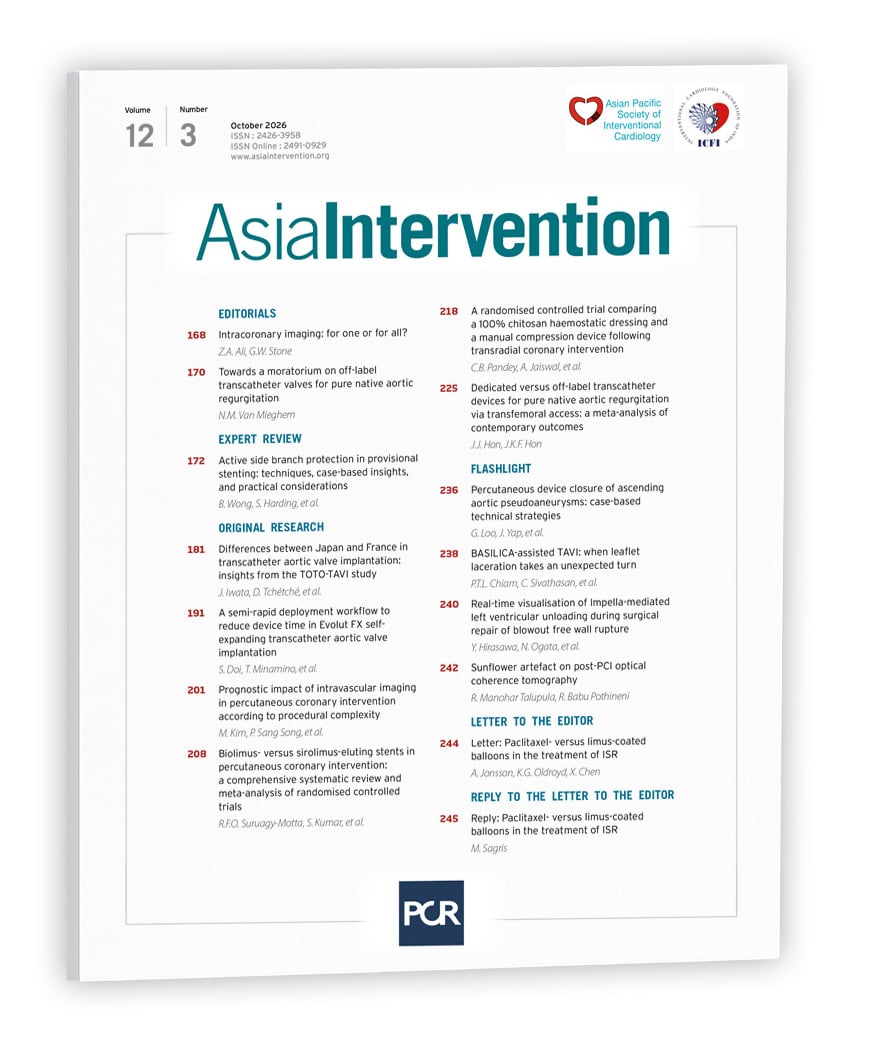
And now, let’s take a tour of the articles in this issue of AsiaIntervention.
We start with an Expert Review from Bernard Wong, Scott Harding et al discussing contemporary active side branch protection methods for use in provisional stenting. Using case-based examples, they cover a number of techniques including conventional, contemporary, and modified jailed balloon techniques, active transfer of plaque, jailed microcatheter technique as well as side branch rescue.
We then move to Original Research, starting with Juri Iwata, Didier Tchétché et al who compare clinical outcomes after transcatheter aortic valve intervention (TAVI) in France and Japan. In addition to evaluating the primary endpoint of in-hospital death, their study includes a review of periprocedural safety outcomes and 3-year all-cause mortality as well as a subgroup analysis of independent TAVI risk in each country. Despite differences in body and aortic valve sizes, and differences in operative risk, comparable results were found between the two countries.
Next, Shinichiro Doi, Toru Minamino et al evaluate a semi-rapid pacing-assisted deployment workflow for the Evolut platform, designed to shorten device time while maintaining procedural success. The primary outcome included procedure-related metrics, and secondary endpoints focused on early valve-related and clinical outcomes. A clinically meaningful reduction in device time was achieved, without differences in early valve performance or short-term adverse events.
Then Mijoo Kim, Pil Sang Song et al assess the effects of percutaneous coronary intervention (PCI) guided by intravascular imaging (IVI), specifically comparing groups of patients at low, moderate, and high risk. The risk of target vessel failure (TVF) increased with procedural complexity, and using IVI was found to reduce the TVF risk significantly in the moderate- and high-risk groups, suggesting its benefit in complex PCI. This article is accompanied by an editorial from Ziad A. Ali and Gregg W. Stone.
This is followed by a systematic review and meta-analysis evaluating the clinical efficacy and safety of biolimus-eluting stents (BES) versus sirolimus-eluting stents (SES) in patients undergoing percutaneous coronary intervention, by Ricardo F.O. Suruagy-Motta, Sant Kumar et al. Their analysis of 6 studies focused on all-cause and cardiac mortality and found that BES offer a short-term reduction in cardiac mortality, warranting further study.
C.B. Pandey, Aniket Jaswal et al compare the use of a 100% chitosan haemostatic dressing (CHD) with a manual compression device following transradial coronary intervention. CHDs rapidly achieved haemostasis, with minimal rebleeding and lower radial artery occlusion risk compared to MCDs.
Finally, Joshua J. Hon, Archie Egrilmezer and Jimmy K.F. Hon assess the outcomes of dedicated versus off-label transcatheter devices used for patients undergoing transfemoral TAVI with pure native aortic regurgitation. This systematic review of 24 studies used 30-day mortality as its primary endpoint and found superior procedural outcomes in dedicated devices compared with off-label devices. Nicolas M. Van Mieghem comments in an accompanying editorial.
These articles are followed by a range of Flashlights that cover cases including the percutaneous device closure of an ascending aortic pseudoaneurysm by Germaine Loo, Jonathan Yap et al; Paul T.L. Chiam, Cumaraswamy Sivathasan et al describing an unexpected event during leaflet laceration in BASILICA-assisted TAVI; Yoshiaki Hirasawa, Nobuhiko Ogata et al on the use of Impella for left ventricular unloading during surgical repair of blowout free wall rupture; and Ram Manohar Talupula and Ramesh Babu Pothineni investigate a sunflower-like artefact on post-PCI optical coherence tomography.
Happy reading,
Upendra Kaul, Editor-in-Chief