Optical coherence tomography (OCT) is frequently used after percutaneous coronary intervention (PCI) to assess stent expansion, edge complications, tissue protrusion, and strut apposition.123 Interpretation must account for acquisition artefacts, because overcalling an artefact as malapposition can prompt unnecessary high-pressure post-dilatation. The sunflower artefact is a recognised pitfall in metallic stents: with an eccentrically positioned imaging catheter, bright strut reflections may appear to converge towards the catheter and simulate floating struts or malapposition.4
A 42-year-old female underwent coronary computed tomography angiography due to a moderate pretest probability for coronary artery disease. Her calcium score was 82, and a severe 80-90% stenosis was identified in the proximal left anterior descending artery (LAD). Invasive coronary angiography confirmed an 80-90% proximal LAD stenosis without marked tortuosity, heavy calcification, or significant bifurcation involvement. Written informed consent was obtained from the patient.
After predilatation with a 2.5 mm balloon, a 3.5×30 mm Resolute Onyx drug-eluting stent (Medtronic) was implanted in the proximal LAD. Post-dilatation was performed with a 3.5 mm non-compliant balloon at 18 atm, with proximal optimisation using a 3.5×6 mm balloon. No final kissing balloon inflation was required. The final angiographic result showed no residual stenosis and Thrombolysis in Myocardial Infarction 3 flow.
Post-PCI OCT was performed with a Dragonfly OpStar imaging catheter (Abbott). Multiple adjacent frames showed apparent diagonally displaced and partially floating struts directed towards the catheter, producing a sunflower-like pattern, initially suggesting malapposition (Figure 1, Moving image 1). Apposition was reassessed by reviewing contiguous frames, the longitudinal reconstruction, and the eccentric catheter position. Using conventional strut-to-wall assessment on contiguous frames, the apparent gaps were within an acceptable apposition range after accounting for the stent strut/reflection profile and vessel contour. There was no persistent separation across adjacent frames, underexpansion, edge dissection, nor clinically relevant tissue protrusion. No further post-dilatation was performed. The patient was discharged without events and remained asymptomatic at two-month follow-up.
This case is not intended to describe a new OCT artefact but to emphasise a recognised pitfall with direct procedural implications. Balloon-expanded metallic struts normally appose the vessel wall in a predominantly radial fashion; true oblique contact or diagonal floating should be suspected only when it persists across frames and correlates with the longitudinal view or an anatomical/mechanical explanation such as vessel curvature, eccentric calcified plaque, bifurcation or side-branch geometry, stent deformation, overlap, or underexpansion. In the present case, the apparent diagonal orientation followed the eccentric catheter rather than the vessel wall, supporting the likelihood of it being a sunflower artefact. Before treating apparent malapposition, operators should correlate the cross-sectional image with the catheter position, adjacent frames, and longitudinal reconstruction to avoid unnecessary post-dilatation and potential vessel injury.
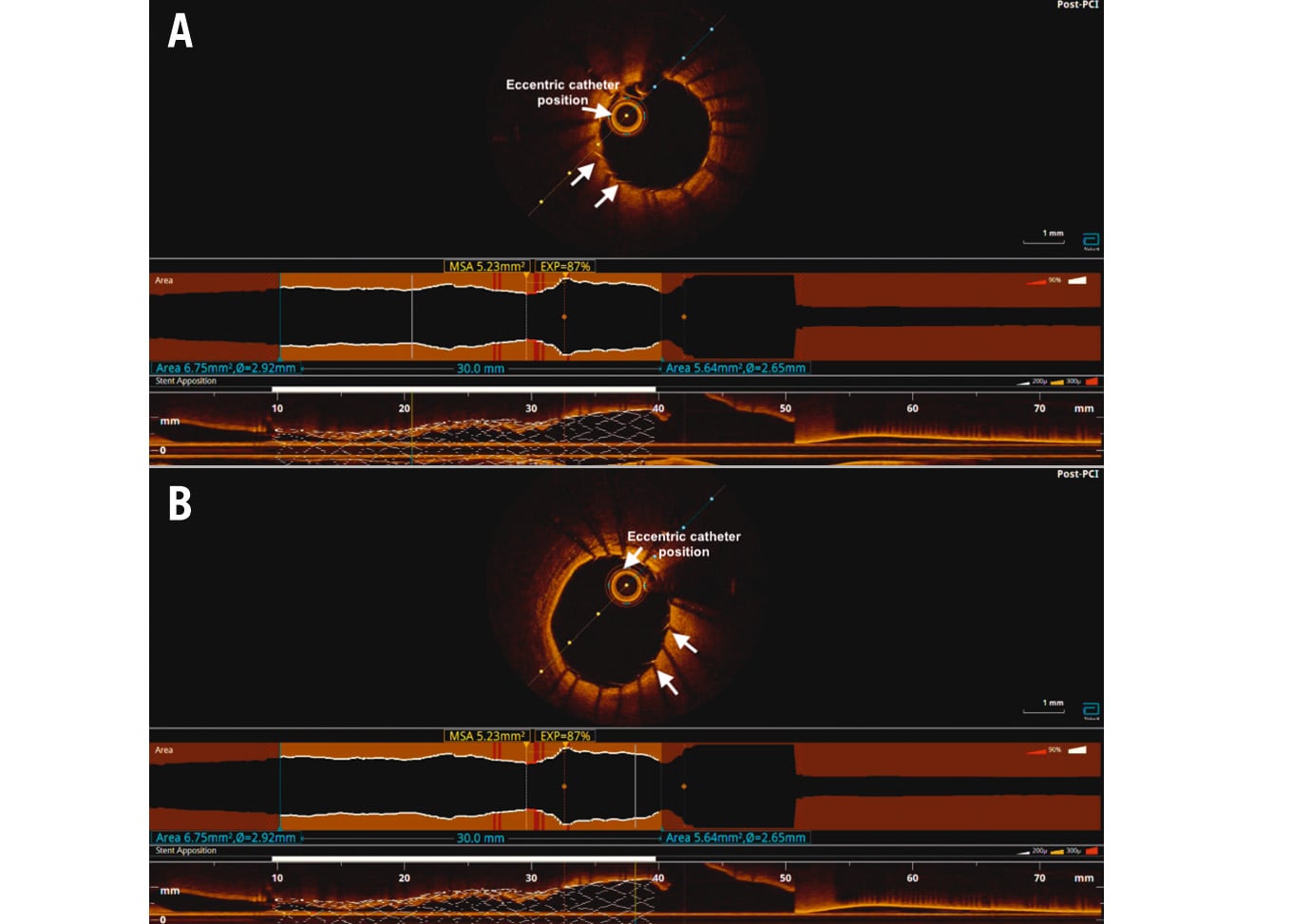
Figure 1. Sunflower artefact on post-PCI optical coherence tomography. A, B) Post-stenting OCT cross-sections, acquired after implantation of a 3.5×30 mm Resolute Onyx drug-eluting stent in the proximal LAD. The OCT imaging catheter is eccentrically positioned within the stented segment. Apparent diagonally displaced/floating struts are directed towards the catheter, creating a sunflower-like appearance and mimicking malapposition. Review of adjacent frames, the longitudinal reconstruction, and the pullback shown in Moving image 1 confirmed acceptable apposition with no true malapposition. LAD: left anterior descending artery; OCT: optical coherence tomography; PCI: percutaneous coronary intervention
Conflict of interest statement
The authors have no conflicts of interest to declare.