The excellent clinical outcomes of transcatheter aortic valve implantation (TAVI) for the short- to midterm are well established,1234 and the indications for TAVI are rapidly expanding to include younger and lower-risk patients with aortic stenosis.56 Therefore, the number of TAVI cases is increasing worldwide. Consequently, understanding the patient population and clinical characteristics of TAVI has become increasingly important. Recent studies, including a pivotal randomised controlled trial, have placed particular emphasis on patients with a small aortic annulus.789 This issue is particularly pertinent for the Asian population, who frequently have a small aortic annulus and are more likely to experience prosthesis-patient mismatch (PPM) and elevated transvalvular pressure gradients (PGs) when treated with TAVI.10111213 However, despite TAVI being performed using a common device system worldwide, studies evaluating regional differences in TAVI outcomes remain limited. Previous studies – initiated in Europe when TAVI was introduced – comparing early outcomes in Asia with those in Europe demonstrated that TAVI could be safely implemented even in smaller-framed Asians.1415 Recently, however, TAVI devices have evolved, and treatment strategies are becoming established. As in the era anticipating the expansion of TAVI indications to broader populations, it will be crucial to develop treatment strategies informed by an understanding of regional differences. This study aimed to compare clinical outcomes after TAVI between Asia and Europe using the latest database from two large hospitals.
Methods
Study cohort
The Tokyo-Toulouse-Transcatheter Aortic Valve Implantation (TOTO-TAVI) study is an ongoing prospective multicentre cohort study involving patients with aortic stenosis undergoing TAVI. This registry was conducted at Keio University Hospital (Tokyo, Japan) and at Clinique Pasteur (Toulouse, France). These two centres were among the hospitals that had the largest case numbers in each country. Data were collected from all consecutive patients undergoing TAVI for severe aortic stenosis using SAPIEN 3 (Japan, 2016-2023; France, 2016-2024), SAPIEN 3 Ultra (France, 2023-2024), SAPIEN 3 Ultra RESILIA (Japan, 2023-2024; all SAPIEN devices: Edwards Lifesciences), Evolut R (Japan, 2016-2019; France, 2016-2022), Evolut PRO (Japan, 2018-2021; France, 2017-2023), Evolut PRO+ (Japan, 2020-2023; France, 2021-2024), Evolut FX (Japan, 2022-2024; France, 2022-2024; all Evolut devices: Medtronic), Navitor (Japan, 2022-2024; France, 2022-2024), or Navitor Vision (Japan, 2024; both Navitor devices: Abbott) between May 2016 and October 2024 at two centres. The valves used in France included several devices not used in Japan (such as Myval [Meril Life Sciences] or ACURATE [Boston Scientific] series), which were excluded from analysis. Device selection was determined by each institutional Heart Team.
The baseline clinical, procedural, and follow-up data were prospectively captured and recorded in a dedicated database. All procedural complications were defined according to the Valve Academic Research Consortium (VARC)-3 criteria and were systematically collected.6 Patients undergoing valve-in-valve or transcatheter aortic valve (TAV)-in-TAV procedures were excluded from the current analysis. This study was conducted in compliance with the principles of the Declaration of Helsinki. All patients provided informed consent for the use of their medical records for research purposes.
Endpoint definitions
The primary endpoint of this study was in-hospital death in patients undergoing TAVI. Periprocedural safety outcomes, including in-hospital death, cardiovascular death, conversion to open surgery, coronary obstruction, disabling stroke, transient ischaemic attack, acute kidney dysfunction, major bleeding, minor bleeding, major vascular complication, minor vascular complication, new pacemaker implantation, and new onset of atrial fibrillation, were evaluated. Each outcome has been defined with reference to the VARC-3 definition.6 Three-year all-cause mortality was also evaluated. A subgroup analysis was performed to assess TAVI risks according to each country using multivariable analysis. The composite in-hospital outcomes included death, all strokes, and all bleeding after TAVI.
Echocardiography and laboratory tests
Transthoracic echocardiography and laboratory tests were performed before the procedure and at discharge after TAVI. PPM was categorised based on prosthesis effective orifice area (EOA) indexed to body surface area as severe (≤0.65 cm2/m2) or moderate (>0.65 cm2/m2 to 0.85 cm2/m2) in the non-obese population, and as severe (≤0.55 cm2/m2) or moderate (>0.55 cm2/m2 to 0.70 cm2/m2) in the obese population (those with a body mass index ≥30 kg/m2).16 Experienced echocardiographers analysed the results.
Statistical analysis
Categorical variables are reported as frequencies and percentages, and differences were evaluated using the chi-square test or two-tailed Fisher’s exact test. Continuous variables are presented as mean±standard deviation or median with interquartile range (IQR) and were compared between groups using the two-sample t-test or the Mann-Whitney U test as appropriate. Multivariable logistic regression analyses were performed to calculate odds ratios (ORs) and 95% confidence intervals (CIs) for the clinical endpoints. The regression model was constructed based on the 17 baseline variables that may have affected the study outcomes. The variables included age, sex, body mass index, haemoglobin, New York Heart Association (NYHA) Class III or IV, Society of Thoracic Surgeons Predicted Risk of Mortality (STS-PROM) score, atrial fibrillation, chronic pulmonary disease, chronic kidney disease, peripheral artery disease, previous coronary artery bypass grafting, previous cerebral vascular disease, left ventricular ejection fraction, bicuspid annulus, transfemoral approach, local anaesthesia, and self-expanding valves. All p-values were two-sided; a p-value<0.05 was considered statistically significant for all tests. For the analysis of 3-year all-cause mortality, the missing follow-up data were imputed using multiple imputation. After multiple imputation, the Cox regression model was used to calculate hazard ratios (HRs) and 95% CIs for the clinical endpoints. The model was constructed based on the 16 variables that could potentially affect study outcomes: age, sex, body mass index, haemoglobin, chronic kidney disease, chronic pulmonary disease, coronary artery disease, peripheral artery disease, NYHA Class III or IV, STS-PROM score, atrial fibrillation, left ventricular ejection fraction, annulus area, local anaesthesia, balloon-expandable or self-expanding valve, and severe PPM. All data analyses were performed using SPSS Statistics, version 29.0 (IBM).
Results
Study population and baseline characteristics
Among 6,967 consecutive patients who underwent TAVI between May 2016 and October 2024 at Clinique Pasteur and Keio University Hospital, 4,771 and 1,422 patients, respectively, met the inclusion criteria and were analysed (Central illustration, Figure 1). The baseline characteristics of the cohort are presented in Table 1. There were many significant differences in the background characteristics between Japan and France, including age (84.4±5.5 years vs 83.4±5.9 years), male sex (39.0% vs 54.0%), body mass index (22.5±3.7 kg/m2 vs 26.5±5.0 kg/m2), body surface area (1.45±0.18 m2 vs 1.76±0.22 m2), STS-PROM score (5.0 [IQR 3.5-7.8]% vs 3.6 [IQR 2.4-5.5]%), haemoglobin level (11.7±1.6 g/dL vs 12.8±1.6 g/dL), hypertension (72.7% vs 78.2%), haemodialysis (8.6% vs 1.4%), chronic pulmonary disease (8.9% vs 15.8%), chronic kidney disease (73.0% vs 49.7%), coronary artery disease (33.1% vs 42.2%), peripheral artery disease (8.9% vs 12.6%), the incidence of left bundle branch block (3.2% vs 10.6%), and history of percutaneous coronary intervention (19.4% vs 29.8%; p<0.001 for all comparisons). In echocardiographic evaluation before TAVI, comparing Japan and France, there were differences in aortic valve area (0.63±0.18 cm2 vs 0.80±0.23 cm2), indexed aortic valve area (0.43±0.12 cm2/m2 vs 0.45±0.14 cm2/m2), peak flow velocity (4.6±0.71 m/s vs 4.2±0.62 m/s), left ventricular ejection fraction (62.4±10.5% vs 59.1±11.9%), systolic pulmonary artery pressure (33.0±10.8 mmHg vs 42.1±11.0 mmHg; p<0.001 for all). In computed tomography assessment before TAVI, patients in Japan showed significantly smaller anatomy than those in France, including annulus area (399±72 mm2 vs 458±94 mm2), annulus perimeter (22.9±2.0 mm vs 24.5±2.5 mm), minimum lumen diameter (right: 6.3±1.2 mm vs 8.3±1.7 mm, left: 6.1±1.2 mm vs 8.2±1.7 mm; p<0.001 for all comparisons).
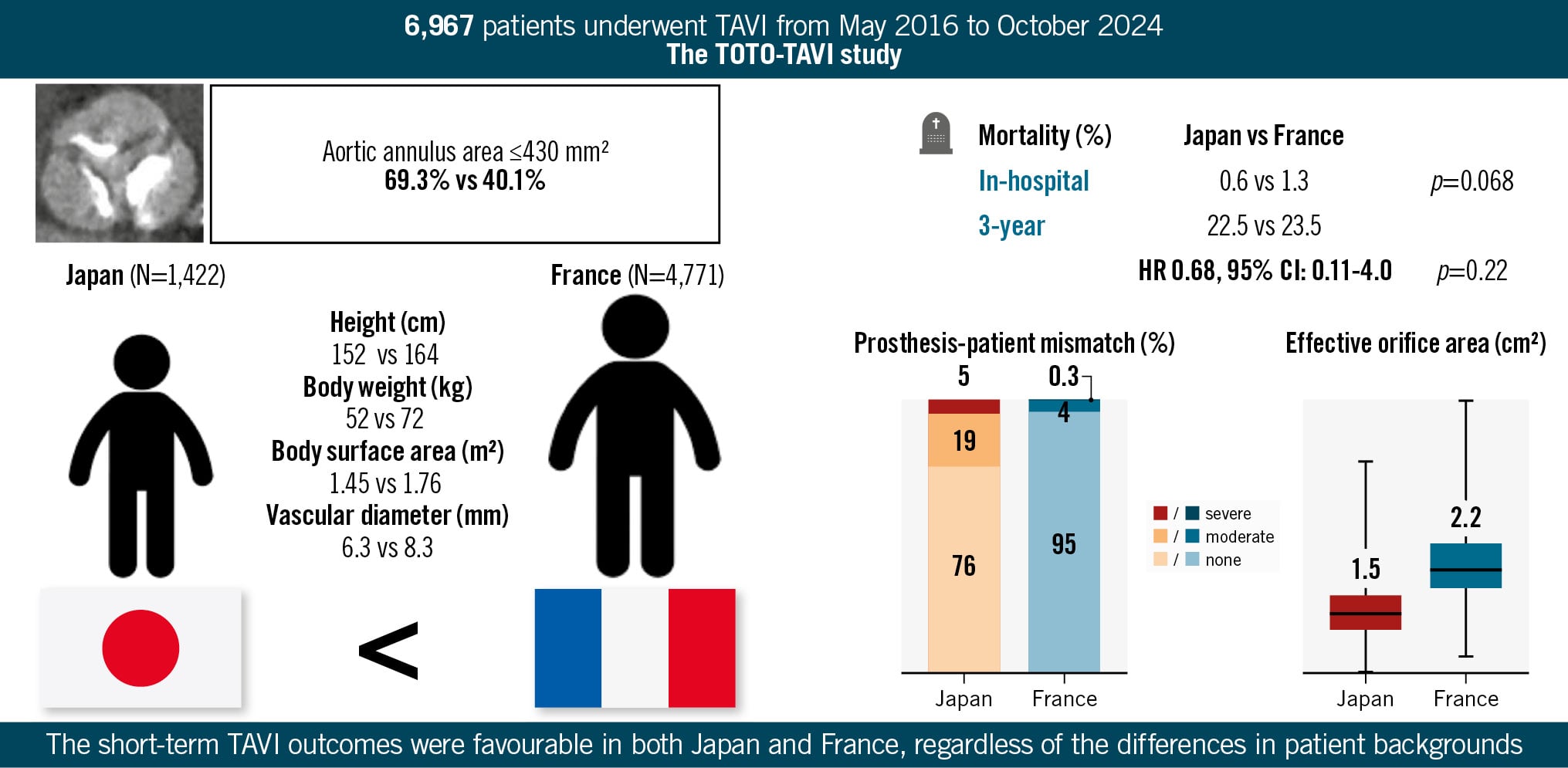
Central illustration. Comparison of patient backgrounds and clinical outcomes of transcatheter aortic valve implantation in Asia and Europe. CI: confidence interval; HR: hazard ratio; TAVI: transcatheter aortic valve implantation
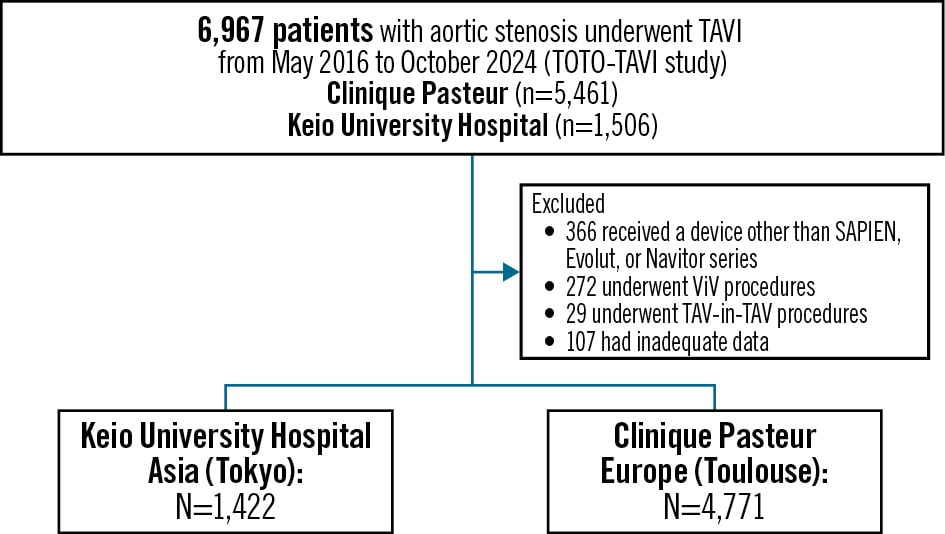
Figure 1. The TOTO-TAVI study cohort. TAV: transcatheter aortic valve; TAVI: transcatheter aortic valve implantation; ViV: valve-in-valve
Table 1. Baseline characteristics compared between Japan and France.
| Japan N=1,422 | France N=4,771 | p-value | |
|---|---|---|---|
| Age, years | 84.4±5.5 | 83.4±5.9 | <0.001 |
| Male sex | 555 (39.0) | 2,577 (54.0) | <0.001 |
| Height, cm | 152.5±9.3 | 164.5±9.0 | <0.001 |
| Weight, kg | 52.5±10.9 | 72.0±15.5 | <0.001 |
| Body mass index, kg/m2 | 22.5±3.7 | 26.5±5.0 | <0.001 |
| Body mass index ≥30 kg/m2 | 44 (3.1) | 980 (20.7) | <0.001 |
| Body surface area, m2 | 1.45±0.18 | 1.76±0.22 | <0.001 |
| STS-PROM score, % | 5.0 (3.5-7.8) | 3.6 (2.4-5.5) | <0.001 |
| NYHA III or IV | 375 (26.4) | 1,295 (27.1) | 0.004 |
| Haemoglobin, g/dL | 11.7±1.6 | 12.8±1.6 | <0.001 |
| Concomitant diseases | |||
| Hypertension | 1,033 (72.7) | 3,718 (78.2) | <0.001 |
| Diabetes mellitus | 374 (26.4) | 1,105 (23.2) | 0.015 |
| Dyslipidaemia | 680 (48.0) | 2,205 (46.3) | 0.286 |
| Haemodialysis | 122 (8.6) | 65 (1.4) | <0.001 |
| Chronic pulmonary disease | 126 (8.9) | 749 (15.8) | <0.001 |
| Chronic kidney disease | 1,038 (73.0) | 2,339 (49.7) | <0.001 |
| Coronary artery disease | 470 (33.1) | 2,008 (42.2) | <0.001 |
| Peripheral artery disease | 127 (8.9) | 598 (12.6) | <0.001 |
| Carotid stenosis | 75 (5.3) | 363 (7.9) | 0.001 |
| Electrocardiogram | |||
| Atrial fibrillation | 301 (21.2) | 956 (20.1) | 0.39 |
| LBBB | 45 (3.2) | 505 (10.6) | <0.001 |
| RBBB | 194 (13.7) | 603 (12.7) | 0.337 |
| Previous history | |||
| History of PCI | 276 (19.4) | 1,416 (29.8) | <0.001 |
| History of CABG | 49 (3.4) | 223 (4.7) | 0.012 |
| History of cerebrovascular disease | 106 (7.5) | 415 (8.7) | 0.143 |
| Echocardiographic data | |||
| Aortic valve area, cm2 | 0.63±0.18 | 0.80±0.23 | <0.001 |
| Indexed aortic valve area, cm2/m2 | 0.43±0.12 | 0.45±0.14 | <0.001 |
| Peak flow velocity, m/s | 4.6±0.71 | 4.2±0.62 | <0.001 |
| Aortic valve mean gradient, mmHg | 48.8±17.0 | 47.1±13.7 | 0.497 |
| Left ventricular ejection fraction, % | 62.4±10.5 | 59.1±11.9 | <0.001 |
| Left ventricular ejection fraction <40% | 68 (4.8) | 440 (9.2) | <0.001 |
| Systolic pulmonary artery pressure, mmHg | 33.0±10.8 | 42.1±11.0 | <0.001 |
| Severe pulmonary hypertension | 31 (2.2) | 344 (7.2) | <0.001 |
| Computed tomography | |||
| Annulus area, mm2 | 399±72 | 458±94 | <0.001 |
| Annulus area ≤430 mm2 | 985 (69.3) | 1,914 (40.1) | <0.001 |
| Annulus perimeter, mm | 22.9±2.0 | 24.5±2.5 | <0.001 |
| Bicuspid annulus | 34 (2.4) | 296 (6.2) | <0.001 |
| Minimum lumen diameter (right), mm | 6.3±1.2 | 8.3±1.7 | <0.001 |
| Minimum lumen diameter (left), mm | 6.1±1.2 | 8.2±1.7 | <0.001 |
| Values are mean±standard deviation, median (interquartile range), or n (%). P-values are from Fisher’s exact test (2×2 comparison), the chi-square test (nx2 comparisons), or t-tests (continuous parameters). CABG: coronary artery bypass grafting; LBBB: left bundle branch block; NYHA: New York Heart Association; PCI: percutaneous coronary intervention; RBBB: right bundle branch block; STS-PROM: Society of Thoracic Surgeons Predicted Risk of Mortality | |||
Procedural characteristics and echocardiographic outcomes
Periprocedural characteristics are summarised in Table 2 and Figure 2. The proportions of patients managed with the transfemoral approach and local anaesthesia were significantly higher in Japan than in France (transfemoral: 98.7% vs 97.8%; p=0.041; local anaesthesia: 97.8% vs 96.8%; p=0.044), though the differences were small. Differences in valve types showed a higher prevalence of balloon-expandable valves in Japan and self-expanding valves in France (SAPIEN: 79.0% vs 33.1%; Evolut: 15.5% vs 63.4%; Navitor: 5.5% vs 3.5%; p<0.001). Furthermore, based on anatomical differences in the aortic valve complex, the valve sizes used were significantly smaller in Japan compared with in France. Regarding the echocardiographic evaluations, patients in Japan had a significantly smaller EOA (1.53±0.42 cm2 vs 2.30±0.59 cm2) and indexed EOA (1.05±0.28 cm2/m2 vs 1.31±0.37 cm2/m2), resulting in a higher incidence of PPM (none: 74.3% vs 82.7%; moderate: 18.6% vs 3.6%; severe: 5.2% vs 0.3%; all p<0.001). The peak flow velocity and mean PG were also higher in patients in Japan than in France (peak flow velocity: 2.4±0.50 m/s vs 2.0±0.44 m/s; mean PG: 11.9±5.3 mmHg vs 9.4±4.2 mmHg; all p<0.001).
Table 2. Procedural and echocardiographic outcomes.
| Japan N=1,422 | France N=4,771 | p-value | |
|---|---|---|---|
| Procedural data | |||
| Transfemoral | 1,403 (98.7) | 4,664 (97.8) | 0.041 |
| Contrast volume, mL | 43±18 | 83±36 | <0.001 |
| Local anaesthesia | 1,391 (97.8) | 4,606 (96.8) | 0.044 |
| Predilatation | 429 (30.2) | 638 (13.5) | <0.001 |
| Valve type | <0.001 | ||
| SAPIEN 3 series | 1,123 (79.0) | 1,579 (33.1) | |
| Evolut series | 221 (15.5) | 3,027 (63.4) | |
| Navitor series | 78 (5.5) | 165 (3.5) | |
| Self-expanding valves | 299 (21.0) | 3,129 (66.9) | <0.001 |
| Valve size | <0.001 | ||
| 20 mm | 77 (5.4) | 0 (0) | |
| 23 mm | 717 (50.4) | 442 (9.3) | |
| 25 mm | 31 (2.2) | 72 (1.5) | |
| 26 mm | 473 (33.3) | 1,593 (33.4) | |
| 27 mm | 16 (1.1) | 45 (0.9) | |
| 29 mm | 102 (7.2) | 2,095 (43.9) | |
| 34 mm | 6 (0.4) | 524 (11.0) | |
| Echocardiographic data | |||
| Effective orifice area, cm2 | 1.53±0.42 | 2.30±0.59 | <0.001 |
| Indexed effective orifice area, cm2/m2 | 1.05±0.28 | 1.31±0.37 | <0.001 |
| Peak flow velocity, m/s | 2.4±0.50 | 2.0±0.44 | <0.001 |
| Mean pressure gradient, mmHg | 11.9±5.3 | 9.4±4.2 | <0.001 |
| Prosthesis-patient mismatch | <0.001 | ||
| None | 1,056 (74.3) | 3,948 (82.7) | |
| Moderate | 265 (18.6) | 171 (3.6) | |
| Severe | 74 (5.3) | 13 (0.3) | |
| Values are mean±standard deviation or n (%). P-values are from Fisher’s exact test (2×2 comparison), the chi-square test (nx2 comparisons), or t-tests (continuous parameters). | |||
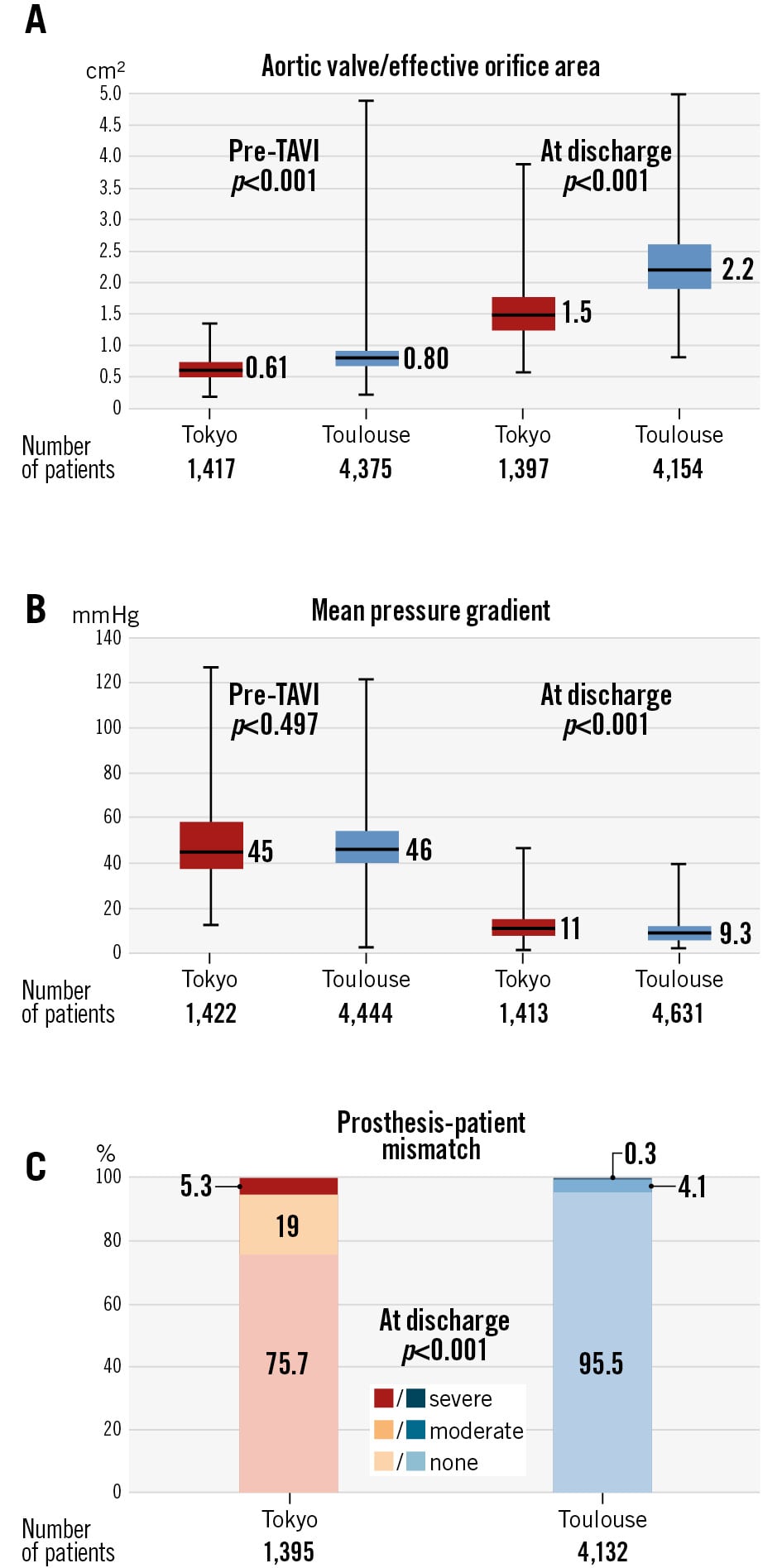
Figure 2. Echocardiographic evaluations before and after TAVI. A) Aortic valve/effective orifice area; (B) mean pressure gradient; (C) prosthesis-patient mismatch. TAVI: transcatheter aortic valve implantation
Complications and clinical outcomes
Periprocedural complications and other clinical outcomes are shown in Table 3. The rate of in-hospital death, the primary endpoint, was comparable between patients in Japan and in France (0.6% vs 1.3%; p=0.068). The rates of cardiovascular death (0.2% vs 1.0%; p=0.003), major bleeding (1.3% vs 3.2%; p<0.001), new pacemaker implantation (7.9% vs 15.3%; p<0.001), and new onset of atrial fibrillation (1.5% vs 3.1%; p=0.002) were lower in Japan than in France. On the other hand, patients in Japan had a longer hospital stay than those in France (8 [IQR 6-13] days vs 6 [IQR 5-7] days; p<0.001), a lower haemoglobin level (10.3±1.6 g/dL vs 11.4±1.7 g/dL; p<0.001), and a higher incidence of minor bleeding (3.3% vs 2.2%; p=0.017). Between the two groups, there were no significant differences in other clinical outcomes, including conversion to open surgery, coronary obstruction, disabling stroke, transient ischaemic attack, acute kidney dysfunction, and major and minor vascular complications.
Table 3. Postprocedural clinical outcomes.
| Japan N=1,422 | France N=4,771 | p-value | |
|---|---|---|---|
| Hospital stay, days | 8 (6-13) | 6 (5-7) | <0.001 |
| ICU stay, days | 1 (1-1) | 1 (1-2) | <0.001 |
| Haemoglobin, g/dL | 10.3±1.6 | 11.4±1.7 | <0.001 |
| In-hospital death | 9 (0.6) | 60 (1.3) | 0.068 |
| Cardiovascular death | 3 (0.2) | 49 (1.0) | 0.003 |
| Conversion to open surgery | 2 (0.1) | 5 (0.1) | 0.724 |
| Coronary obstruction | 7 (0.5) | 10 (0.2) | 0.074 |
| Disabling stroke | 15 (1.1) | 32 (0.7) | 0.147 |
| Transient ischaemic attack | 2 (0.1) | 9 (0.2) | 0.702 |
| Acute kidney dysfunction | 44 (3.1) | 184 (3.9) | 0.171 |
| Major bleeding | 18 (1.3) | 153 (3.2) | <0.001 |
| Minor bleeding | 47 (3.3) | 104 (2.2) | 0.017 |
| Major vascular complication | 34 (2.4) | 116 (2.4) | 0.916 |
| Minor vascular complication | 79 (5.6) | 320 (6.7) | 0.112 |
| New pacemaker implantation | 112 (7.9) | 724 (15.3) | <0.001 |
| New onset of atrial fibrillation | 21 (1.5) | 145 (3.1) | 0.002 |
| Values are mean±standard deviation, median (interquartile range), or n (%). P-values are from Fisher’s exact test (2×2 comparison), the chi-square test (nx2 comparisons), or t-tests (continuous parameters). ICU: intensive care unit | |||
Results for balloon-expandable and self-expanding valves separately
The results of the comparison between Japan and France, separated into balloon-expandable valve procedures and self-expanding valve procedures, are summarised in Supplementary Table 1 and Supplementary Table 2, respectively. Regarding the analysis results of echocardiography and computed tomography, the differences between Japan and France were similar to those observed in the overall cohort. The in-hospital outcomes were also largely similar to those of the overall cohort; however, regarding pacemaker implantation rates, Japan had a lower rate for balloon-expandable valves (5.3% vs 13.3%; p<0.001) and a higher rate for self-expanding valves (17.4% vs 15.3%; p<0.001), compared with France.
Medium-term clinical outcomes
Three-year all-cause mortality is shown in Figure 3. There was no significant difference in 3-year all-cause mortality between Japan and France (22.5% vs 23.5%, HR 0.678, 95% CI: 0.114-4.033; p=0.583). The STS-PROM score was significantly associated with 3-year mortality (HR 1.034, 95% CI: 1.008-1.060; p=0.014). No other factors were significantly associated with the medium-term prognosis.
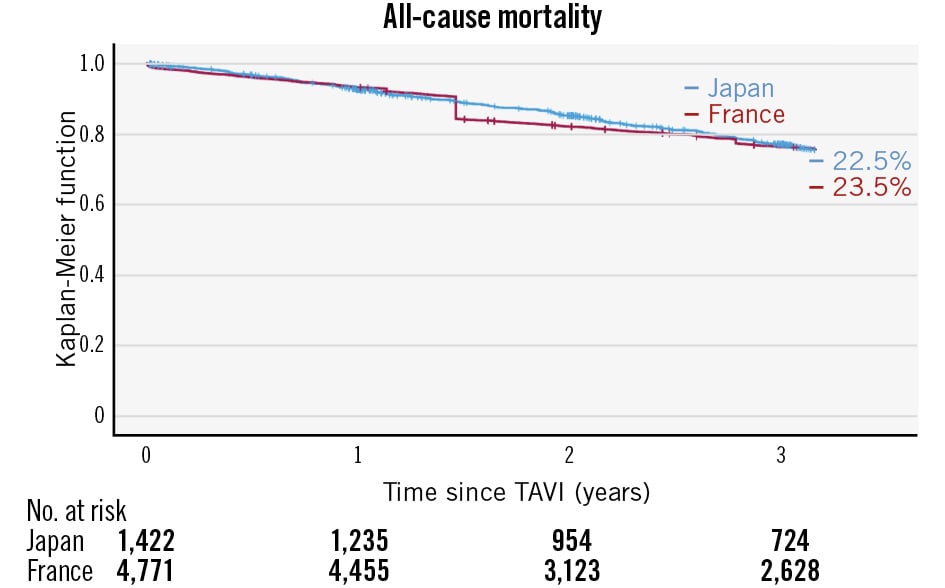
Figure 3. Three-year all-cause mortality comparison between Japan and France. TAVI: transcatheter aortic valve implantation
Subgroup analysis
Multivariable analysis was performed to identify independent predictors of composite in-hospital outcomes, including death, stroke, and bleeding after TAVI for each country (Table 4). In Japan, previous cerebral vascular disease and self-expanding valves tended to increase the risks, but these were not statistically significant. In France, higher body mass index (OR 0.970, 95% CI: 0.947-0.994; p=0.015), higher haemoglobin level (OR 0.826, 95% CI: 0.770-0.887; p<0.001), and local anaesthesia (OR 0.443, 95% CI: 0.246-0.797; p=0.007) were independently associated with reduced in-hospital death. In contrast, female sex (OR 1.310, 95% CI: 1.028-1.669; p=0.029), previous CABG (OR 1.868, 95% CI: 1.182-2.954; p=0.007), previous cerebral vascular disease (OR 1.717, 95% CI: 1.245-2.367; p<0.001), and bicuspid annulus (OR 1.825, 95% CI: 1.228-2.711; p=0.003) were associated with a higher probability of composite in-hospital outcomes.
Table 4. Logistic regression models for in-hospital composite outcomes (death, stroke, and bleeding).
| Japan | France | |||||
|---|---|---|---|---|---|---|
| Variables | OR | 95% CI | p-value | OR | 95% CI | p-value |
| Age | 1.020 | 0.974-1.069 | 0.406 | 1.018 | 0.997-1.040 | 0.087 |
| Female sex | 0.937 | 0.573-1.531 | 0.794 | 1.310 | 1.028-1.669 | 0.029 |
| Body mass index | 1.026 | 0.965-1.090 | 0.417 | 0.970 | 0.947-0.994 | 0.015 |
| Haemoglobin | 1.005 | 0.865-1.168 | 0.944 | 0.826 | 0.770-0.887 | <0.001 |
| NYHA III or IV | 1.493 | 0.908-2.455 | 0.114 | 1.100 | 0.858-1.411 | 0.451 |
| STS-PROM score | 0.960 | 0.901-1.023 | 0.207 | 1.022 | 0.992-1.053 | 0.155 |
| Atrial fibrillation | 0.735 | 0.407-1.328 | 0.308 | 1.005 | 0.764-1.323 | 0.970 |
| Chronic pulmonary disease | 1.181 | 0.574-2.427 | 0.651 | 0.951 | 0.689-1.312 | 0.758 |
| Chronic kidney disease | 1.145 | 0.672-1.952 | 0.619 | 0.912 | 0.725-1.149 | 0.435 |
| Peripheral artery disease | 1.641 | 0.835-3.225 | 0.151 | 1.076 | 0.768-1.509 | 0.669 |
| Previous CABG | 2.222 | 0.783-6.302 | 0.133 | 1.868 | 1.182-2.954 | 0.007 |
| Previous cerebral vascular disease | 1.885 | 0.948-3.751 | 0.071 | 1.717 | 1.245-2.367 | <0.001 |
| Left ventricular ejection fraction | 0.999 | 0.976-1.022 | 0.925 | 1.003 | 0.993-1.014 | 0.498 |
| Bicuspid annulus | 0.590 | 0.077-4.495 | 0.610 | 1.825 | 1.228-2.711 | 0.003 |
| Transfemoral | 1.081 | 0.179-6.519 | 0.932 | 1.390 | 0.598-3.230 | 0.445 |
| Local anaesthesia | 0.251 | 0.057-1.104 | 0.067 | 0.443 | 0.246-0.797 | 0.007 |
| Self-expanding valves | 1.570 | 0.953-2.588 | 0.077 | 1.225 | 0.952-1.576 | 0.115 |
| P-values, ORs, and 95% CIs from the logistic regression model. CABG: coronary artery bypass grafting; CI: confidence interval; NYHA: New York Heart Association; OR: odds ratio; STS-PROM: Society of Thoracic Surgeons Predicted Risk of Mortality | ||||||
Discussion
To the best of our knowledge, this study provides data on the patient backgrounds and clinical outcomes of the largest number of patients using the latest devices in Japan and France. The salient findings from the present analysis comparing patients in Japan and France are summarised as follows: (1) although there were many different aspects in patient backgrounds, in-hospital outcomes (death, disabling stroke, transient ischaemic attack, vascular complications, and surgical conversion) showed no significant differences. 2) The EOA was smaller in Japan than in France. 3) The incidence of PPM was significantly higher in Japan, although the proportion of severe PPM was very low in both groups. 4) The rate of self-expanding valve use and the number of new pacemaker implants were both lower in Japan than in France. 5) There were no statistically significant independent risk factors for composite outcomes (in-hospital death, stroke, and bleeding) in Japan; on the other hand, in France, female sex, higher body mass index, lower haemoglobin, previous coronary artery bypass grafting and cerebrovascular disease, bicuspid annulus, and general anaesthesia were all independent risk factors. 6) There was no significant difference in 3-year all-cause mortality between Japan and France.
This study demonstrated regional differences in patient backgrounds and TAVI outcomes in a large-scale population. Despite significant differences in patient backgrounds, including comorbidities and aortic or vascular diameters, the current results showed that clinical outcomes after TAVI were favourable across both regions, including in-hospital death, complications, and 3-year mortality. These results suggest that TAVI procedures are establishing stable safety regardless of patient risks, such as body size or patient background. It is noteworthy that the incidence of vascular complications remained unchanged despite the significantly smaller minimum femoral vessel diameter observed in Japanese patients. This is likely attributable to advances in TAVI device technology, enabling access with smaller sheaths and improvements in closure devices, allowing for safe performance of TAVI.
Despite patients’ overall higher STS-PROM scores, careful patient management following TAVI may have ensured perioperative safety in Japan. Indeed, Japan showed significantly longer hospital stays than France. Given that most of the patients who underwent TAVI were aged and had various comorbidities, this suggests that ensuring postoperative safety requires management beyond cardiovascular events and necessitates a certain period of hospitalisation.
Furthermore, 3-year all-cause mortality was comparable between Japan and France. This finding suggests that the TAVI devices and procedures steadily improved patient prognosis regardless of valve sizes or regional differences. Although patients in Japan showed a significantly higher incidence of PPM compared with those in France in this study (severe PPM: 5.3% vs 0.3%), the incidence of severe PPM was very low in both Japan and France. As previous studies have primarily identified severe PPM – rather than moderate PPM – as having an impact on long-term prognosis,171819 we believe this may explain why no difference in prognosis was observed in this study. Furthermore, because the follow-up period was limited to 3 years and the patients were of advanced age, longer-term studies are required to evaluate outcomes further. Not only was the native aortic valve complex inherently small but the higher utilisation of balloon-expandable valves compared with self-expanding valves was also considered a reason for the higher rate of PPM in Japan. Recent reports indicate that self-expanding valves performed superiorly with respect to bioprosthetic valve dysfunction up to 12 months compared with balloon-expandable valves for aortic annuli ≤430 mm2.9 Therefore, determining the optimal treatment strategy for patients with smaller anatomy, such as Asian patients, is crucial. However, this study included patients from 2016. The latest valve, the SAPIEN 3 Ultra RESILIA, can provide a larger EOA compared with previous models. Consequently, studies using the latest valves are also essential.1120 Given the small native size of the aortic complex in the Asian population, they are treated with smaller valve sizes, resulting in a smaller EOA. Future studies, including long-term patient and valve function follow-up, are crucial.
The pacemaker implantation rate was higher in France, which may be partly attributed to the greater use of self-expanding valves. However, given that the pacemaker rate following balloon-expandable valve implantation was also higher in France than in Japan, it is important to consider technical factors such as the membrane septum, the depth of valve placement, and the angle of placement. However, since these factors were not included in this registry, conducting a detailed study remains a challenge for the future. Additionally, pacemaker implantation was performed approximately 2 days postoperatively in France. It is known that atrioventricular block after TAVI recovers spontaneously in a certain proportion of cases, suggesting that prompt pacemaker implantation after TAVI may represent overtreatment.
In subgroup analyses, the TAVI outcomes at both hospitals were consistently excellent; as the number of events – specifically deaths and strokes – was very low, a composite endpoint was used rather than a hard endpoint. This suggests that TAVI is a safe and reliable treatment regardless of the region. Factors such as female sex, low body mass index, and low haemoglobin level – which may pose a significant risk for composite in-hospital outcomes in French patients – are patient background factors frequently observed in Japan. However, in-hospital mortality was comparable between Japan and France, and there were no major differences in safety outcomes, including stroke or bleeding events. These results therefore indicate the importance of individually tailored management of comorbidities, including procedural management and medication, based on each patient’s background. As TAVI indications expand, an increasing number of patients with diverse backgrounds will be treated, making an increasingly personalised, tailor-made approach for each patient essential.
Limitations
This study has several limitations inherent to its design. It was based on observational, unblinded, and non-randomised registry data, such that unmeasured variables may have influenced the results. Moreover, one of the limitations of a retrospective registry is that there were significant differences between Japan and France in the types of valves used for TAVI. It cannot be denied that this could be interpreted as a comparison of the valves themselves; therefore, the results of this study should not be overinterpreted as regional differences only. Echocardiographic data were collected according to VARC-3 criteria but were not adjudicated by an independent core laboratory. Regarding paravalvular leakage, while we suspect this may be due to issues with the echocardiographers’ records, 94.8% of cases in the French database were classified as “non-trivial”. Given that 52.3% of cases in Japan were classified as “non-trivial”, it would be a misinterpretation to assume there were significantly worse outcomes in Japan. As this is a significant discrepancy that does not reflect real-world clinical practice, and it suggests that there are issues with the methods used to collect data on paravalvular leakage, we deliberately chose not to make such a comparison. Regarding statistics, we tried to perform propensity score matching, adjusting for baseline characteristics; however, due to the many differences between Japan and France, there remained too few matched cohorts to analyse appropriately. We concluded that this difficulty in matching means the patient profiles differed greatly between groups. Post-TAVI computed tomography data were unavailable, precluding detailed assessment of calcium scores. The types of valves used for TAVI differed between the two regions (for example, SAPIEN 3 Ultra was used in France but not in Japan), so post-TAVI paravalvular leakage assessment could not be performed by echocardiography. In the 3-year mortality comparison, missing survival status and date of death data were imputed using multiple imputation methods; however, this statistical approach is not perfect. It cannot be ruled out that selection bias in the patients whose survival status was confirmed and the low reproducibility of analyses using multiple imputation methods may have influenced the results. However, this study represents a comparison of TAVI procedures performed at the largest and most advanced facilities in Japan and France, and it is considered to retain its novelty and uniqueness.
Conclusions
Although there were many differences in patient characteristics between Japan and France, the clinical outcomes of TAVI, including in-hospital and 3-year outcomes, were similar and excellent. These results suggest that the current TAVI safety profile was established regardless of the patients’ background risks. Future studies clarifying the long-term prognosis or valve durability after TAVI, considering the regional differences, are warranted.
Impact on daily practice
The number of transcatheter aortic valve implantation (TAVI) procedures is increasing worldwide, but studies comparing regional differences remain scarce. The TOTO-TAVI study, which included patients who underwent TAVI in Japan and France, suggested that although patients in Japan showed a significantly smaller body size, a smaller aortic valve, and a higher operative risk than those in France, the in-hospital death rate was comparable between the two groups and there was no significant difference in 3-year all-cause mortality between Japan and France. This study suggests that procedural safety and medium-term prognosis after TAVI were established regardless of the procedural risks.
Conflict of interest statement
K. Hayashida is a clinical proctor for Edwards Lifesciences, Abbott, and Medtronic. H. Shimizu is a clinical proctor at Edwards Lifesciences. N. Dumonteil and D. Tchétché are proctors for Edwards Lifesciences, Abbott, Medtronic, and Boston Scientific. The other authors have no conflicts of interest to declare.