Transcatheter aortic valve implantation (TAVI) has revolutionised the treatment of degenerative calcific aortic stenosis (AS). The most recent guidelines of the European Society of Cardiology (ESC) and the European Association of Cardio-Thoracic Surgery (EACTS) elevated TAVI to the preferred treatment strategy for patients ≥70 years old with favourable anatomy.1 The commercially available balloon-expandable and self-expanding transcatheter valves that were tested in the pivotal TAVI trials were designed to anchor into the calcium of the aortic root or leaflets. The aetiopathology of aortic regurgitation (AR) is fundamentally different from that of AS, as the valve is often devoid of calcium.2 Nevertheless, these same platforms have been entertained to treat patients with pure native AR, relying on excessive valve oversizing. However, the use of these non-dedicated platforms in pure AR has consistently resulted in a higher incidence of transcatheter valve embolisation, migration, the need for more than one transcatheter valve, and residual AR.3
Many patients with aortic regurgitation remain untreated because the AR severity is underestimated or the operative risk is deemed prohibitively elevated. The ESC/EACTS guidelines on valvular disease tackled the issue of AR underestimation by promoting three-dimensional echocardiography and cardiac magnetic resonance imaging for optimal AR quantification.1 This recommendation may help identify patients with moderate-to-severe or severe AR in good time. Conversely, the unmet need for a transcatheter therapy was only partially addressed as TAVI was only granted a Class IIb recommendation for treatment of AR patients who are ineligible for surgery; this recommendation was granted despite acknowledging the surge of dedicated AR valve platforms featuring leaflet-clipping mechanisms to allow anchoring without the need for calcium.
Single-centre and multicentre registries consistently demonstrated that this fundamental modification practically resolved the issue of transcatheter valve migration and embolisation, generating favourable clinical outcomes at 30 days and 1 year.45 In fact, outcome data in AR patients at high operative risk mirrored those of AS patients who underwent TAVI or surgical aortic valve replacement (SAVR) in the pivotal low-risk trials.67
Guidelines typically rely on randomised controlled trials (RCT), meta-analyses, large (prospective) non-randomised studies, expert consensus, and small or retrospective studies and registries, and they are based on the literature up until the inception of writing. Accumulating data from prospective studies and national and international registries reinforced the procedural safety and clinical effectiveness of TAVI with a dedicated valve for AR.8910 The reliable AR elimination and favourable valve haemodynamics further resulted in reverse left ventricular remodelling and improvements in quality of life and functional status up to 2 years of follow up.
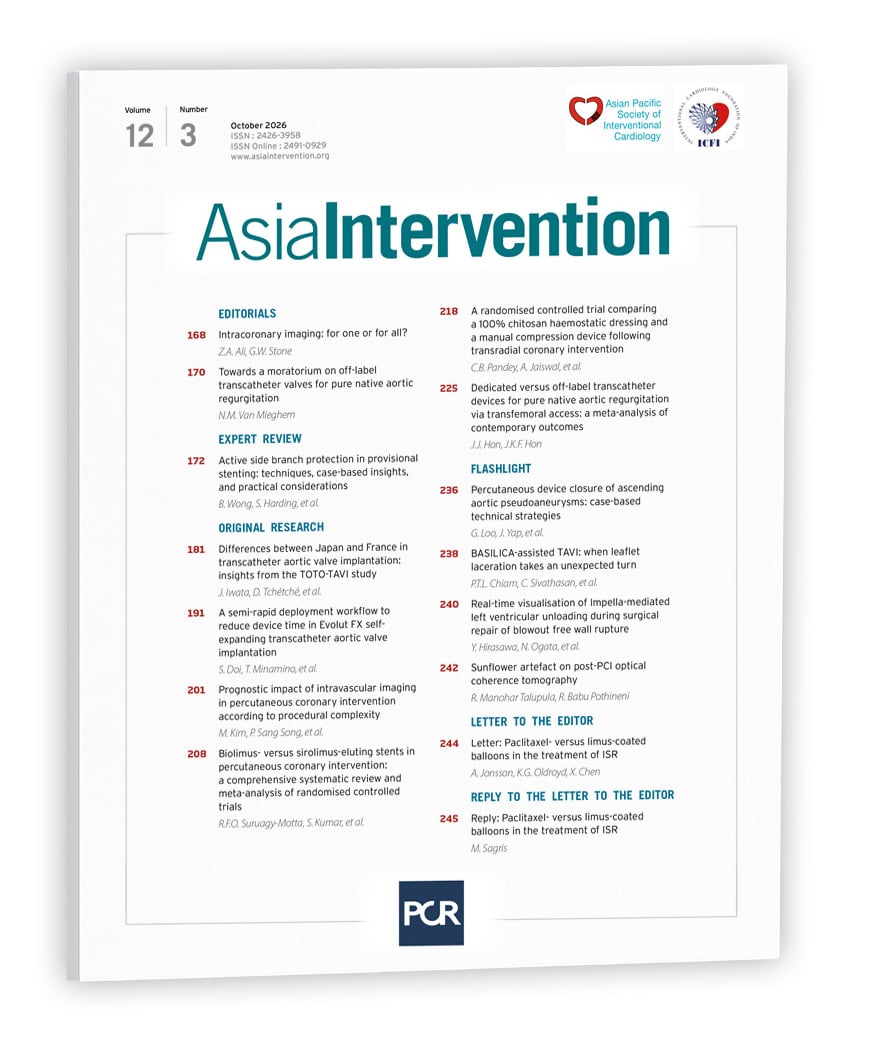
In this issue of AsiaIntervention, Hon and colleagues share a contemporary meta-analysis on TAVI for pure native AR which corroborates these findings and confirms that dedicated transfemoral devices outperform off-label devices for both clinical and valve performance endpoints.11 One can argue whether more clinical and randomised controlled data are required to offer this safe and effective treatment to patients with native pure AR at elevated operative risk.
Of note, the Aortic Regurgitation Trial Investigating Surgery Versus Trilogy (ARTIST; ClinicalTrials.gov: NCT06608823) trial is an ongoing RCT aiming to compare SAVR and TAVI in >1,000 patients with symptomatic severe AR at low or intermediate operative risk, specifically excluding patients at high or prohibitive operative risk.
Collectively, this new reality endorses the adoption of dedicated transcatheter valves and urges against the use of non-dedicated transcatheter valves in the treatment of pure AR in patients at high operative risk. As such, the 2025 European guidelines fall short, and the upcoming updated American guidelines have the unique opportunity to set that record straight and recommend evidence-based optimal therapy for all patients with symptomatic (moderate-to-) severe AR and include a stronger recommendation for dedicated TAVI in AR.
Conflict of interest statement
N.M. Van Mieghem has received research grant support from Abbott, Medtronic, and Boston Scientific; and advisory fees from Abbott, Medtronic, Boston Scientific, JenaValve, Anteris, Pie Medical Imaging, Siemens, and Materialise.