
Skip to content
The reference academic journal by and for the Asia-Pacific interventional cardiology community
AsiaIntervention - 10 Years

AsiaIntervention

  • Current issue
  • Archives
  • How to submit
    • Authors guidelines
    • Submit your paper
    • Reviewers guidelines
  • Services
    • Advertising
    • Article reprints
    • Publication calendar
    • Rights & Permissions
  • About the journal
    • Overview
    • Editorial Board
    • Masthead
  • Contact us
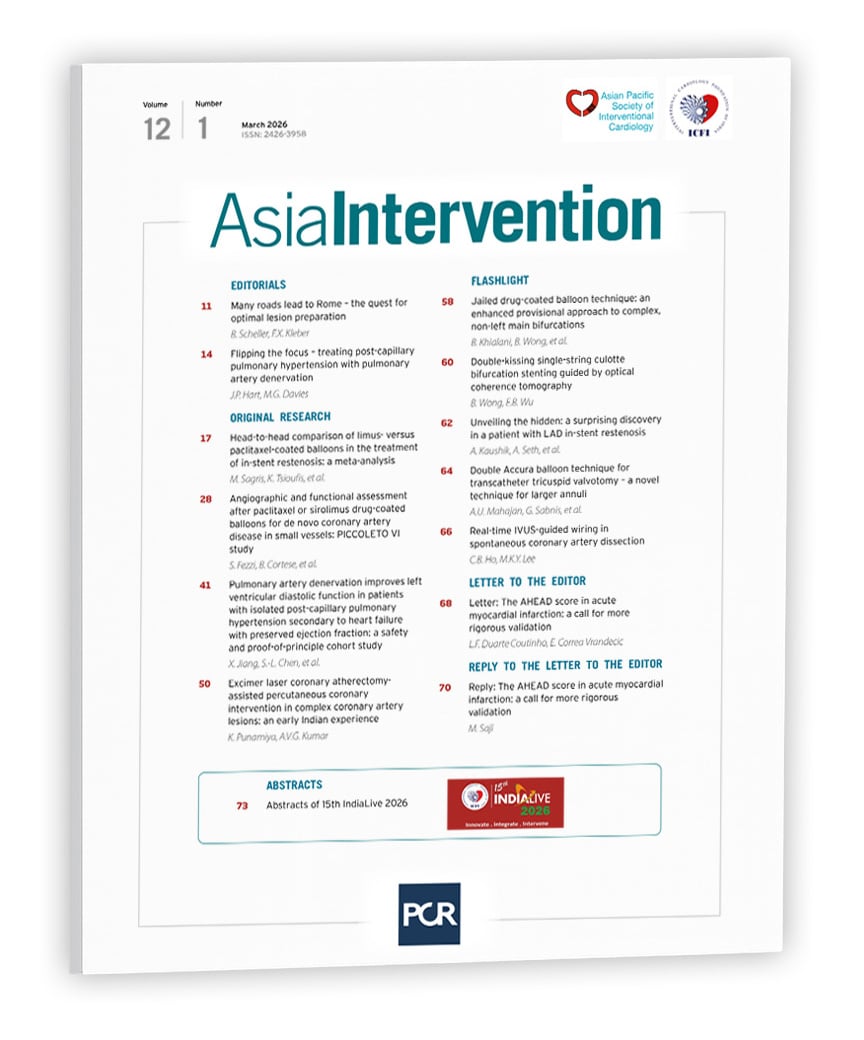
Volume 12 – Number 1 – March 2026

Reply: The AHEAD score in acute myocardial infarction: a call for more rigorous validation

AsiaIntervention 2026;12:70-71 | 10.4244/AIJ-D-25-00097

Mike Saji1,2, MD

1. Department of Cardiology, Sakakibara Heart Institute, Tokyo, Japan; 2. Division of Cardiovascular Medicine, Department of Internal Medicine, Toho University Faculty of Medicine, Tokyo, Japan

We would like to thank Vrandecic et al1 for their great interest in our recent publication in AsiaIntervention2. Our paper highlights the utility of the AHEAD score, originally developed for heart failure patients, for predicting in-hospital mortality in patients with acute myocardial infarction (MI)34. Our study further confirmed its prognostic value for 1-year all-cause mortality, even among those without overt heart failure. This simple bedside tool enables early risk stratification at the time of admission, facilitates clinical decision-making, and can be readily integrated into routine workflows and electronic health records. By enhancing early prognostic evaluation, the AHEAD score supports personalised care strategies, communication with families, and appropriate allocation of healthcare resources. We would like to address the issues raised in their letter.

First, regarding the measurement of creatine kinase (CK), we acknowledge that blood-sampling schedules were determined by local hospital practices. However, the Japan Acute Myocardial Infarction Registry (JAMIR) participating centres are predominantly cardiovascular specialist institutions, and CK levels are routinely assessed every 3-6 hours in the majority of hospitals. Therefore, substantial systematic bias in peak CK measurements is unlikely, which is consistent with the low in-hospital mortality observed in similar nationwide registries5. Furthermore, previous studies have suggested that infarct size is more accurately reflected by the total biomarker release over time rather than by a single peak CK value6. Although our registry did not include the detailed time-concentration profiles required to perform kinetic modelling, such refined assessments may further clarify the relationship between infarct size and outcomes in future studies. Patients without peak CK data were excluded to minimise measurement bias in this study.

Second, as noted, our analysis was a predefined substudy of the JAMIR and was not designed to perform head-to-head comparisons with established risk prediction models such as the Global Registry of Acute Coronary Events (GRACE) or Thrombolysis in Myocardial Infarction (TIMI) scores7. While such comparisons would indeed be informative, they were outside the scope of our investigation8. Importantly, the AHEAD score is intended as a simple bedside tool and does not aim to replace existing models; instead, it may serve as a complementary marker that can be applied immediately at presentation. Future prospective studies comparing the AHEAD score with established models are warranted.

Third, we agree that patients with the highest AHEAD scores were less likely to receive evidence-based therapies, which may contribute to worse outcomes. As shown in Table 1 of our paper2, these patients had a higher prevalence of diabetes, severe renal dysfunction, and prior stroke, and, despite being younger, they may have had a higher burden of frailty not captured in our dataset. Such conditions could understandably lead clinicians to avoid invasive procedures, including transcatheter therapies. Indeed, a door-to-balloon time <90 minutes was an independent predictor of in-hospital mortality, supporting the notion that conservative management may influence outcomes. Nevertheless, in sensitivity analyses adjusting for treatment-related variables (Table 2, Table 3)2, the AHEAD score remained independently associated with 1-year all-cause mortality, underscoring its robustness as a prognostic indicator. Finally, based on previous reports, healthcare disparities related to social or structural factors are relatively limited in our country9.

We appreciate the insightful comments provided by Vrandecic et al, which will help refine future research regarding this important topic.

Conflict of interest statement

The author has no conflicts of interest to declare.
Share

References

  • Duarte Coutinho LF, Vrandecic EC.. Letter: The AHEAD score in acute MI: a call for more rigorous validation. AsiaIntervention 2026;
  • Saji M, Honda S, Nishihira K, Kojima S, Takegami M, Asaumi Y, Yamashita J, Hibi K, Takahashi J, Sakata Y, Takayama M, Sumiyoshi T, Ogawa H, Kimura K, Yasuda S, Of The Jamir Investigators OB. The AHEAD score as a predictor of all-cause mortality in patients with acute myocardial infarction: a secondary analysis of the Japan Acute Myocardial Infarction Registry. AsiaIntervention 2025;11:170-7
  • Spinar J, Jarkovsky J, Spinarova L, Mebazaa A, Gayat E, Vitovec J, Linhart A, Widimsky P, Miklik R, Zeman K, Belohlavek J, Malek F, Felsoci M, Kettner J, Ostadal P, Cihalik C, Vaclavik J, Taborsky M, Dusek L, Littnerova S, Parenica J. AHEAD score–Long-term risk classification in acute heart failure. Int J Cardiol 2016;202:21-6
  • Chen YJ, Sung SH, Cheng HM, Huang WM, Wu CL, Huang CJ, Hsu PF, Yeh JS, Guo CY, Yu WC, Chen CH. Performance of AHEAD Score in an Asian Cohort of Acute Heart Failure With Either Preserved or Reduced Left Ventricular Systolic Function. J Am Heart Assoc 2017;6:e004297
  • Yamaji K, Kohsaka S, Inohara T, Numasawa Y, Ishii H, Amano T, Ikari Y. Population Density Analysis of Percutaneous Coronary Intervention for ST-Segment-Elevation Myocardial Infarction in Japan. J Am Heart Assoc 2020;9:e016952
  • Chia S, Senatore F, Raffel OC, Lee H, Wackers FJ, Jang IK. Utility of cardiac biomarkers in predicting infarct size, left ventricular function, and clinical outcome after primary percutaneous coronary intervention for ST-segment elevation myocardial infarction. JACC Cardiovasc Interv 2008;1:415-23
  • Eagle KA, Lim MJ, Dabbous OH, Pieper KS, Goldberg RJ, Van de Werf F, Goodman SG, Granger CB, Steg PG, Gore JM, Budaj A, Avezum A, Flather MD, Fox KA; GRACE Investigators. A validated prediction model for all forms of acute coronary syndrome: estimating the risk of 6-month postdischarge death in an international registry. JAMA 2004;291:2727-33
  • Yasuda S, Honda S, Takegami M, Nishihira K, Kojima S, Asaumi Y, Suzuki M, Kosuge M, Takahashi J, Sakata Y, Takayama M, Sumiyoshi T, Ogawa H, Kimura K; JAMIR Investigators. Contemporary Antiplatelet Therapy and Clinical Outcomes of Japanese Patients With Acute Myocardial Infarction – Results From the Prospective Japan Acute Myocardial Infarction Registry (JAMIR). Circ J 2019;83:1633-43
  • Itoshima H, Shin JH, Sasaki N, Goto E, Kunisawa S, Imanaka Y. Regional variations in primary percutaneous coronary intervention for acute myocardial infarction patients: A trajectory analysis using the national claims database in Japan. PLoS One 2024;19:e0312248

Volume 12 - Number 1

View full issue

Download this article
Authors
  • Mike Saji
AsiaIntervention - 10 Years
  • Readers
    • Archives
    • Subscribe to the newsletter
    • Contact us
  • About the journal
    • Overview
    • Editorial Board
    • Masthead
  • Services
    • Advertising in AsiaIntervention
    • Article reprints
    • Publication calendar
    • Rights & Permissions
  • Authors
    • Authors guidelines
    • Submit your paper
  • Legal
    • Disclaimer
    • Cookies Policy
    • Privacy Policy
    • Legal Notice
  • Follow us
    • Facebook
    • X
    • LinkedIn
Online ISSN 2491-0929 - Print ISSN 2426-3958
© 2015-2026 Europa Group - All rights reserved