
Skip to content
The reference academic journal by and for the Asia-Pacific interventional cardiology community
AsiaIntervention - 10 Years

AsiaIntervention

  • Current issue
  • Archives
  • How to submit
    • Authors guidelines
    • Submit your paper
    • Reviewers guidelines
  • Services
    • Advertising
    • Article reprints
    • Publication calendar
    • Rights & Permissions
  • About the journal
    • Overview
    • Editorial Board
    • Masthead
  • Contact us
Volume 12 – Number 1 – March 2026

Many roads lead to Rome – the quest for optimal lesion preparation

AsiaIntervention 2026;12:11-13 | 10.4244/AIJ-D-26-00005

Bruno Scheller1, MD; Franz X. Kleber2, MD

1. Clinical and Experimental Interventional Cardiology, University of Saarland, Homburg/Saar, Germany; 2. Charité – Universitätsmedizin Berlin, Deutsches Herzzentrum der Charité, Klinik für Kardiologie, Angiologie & Intensivmedizin – Forschung, Berlin, Germany

The publication of the first-in-human data on the treatment of in-stent restenosis in the 2000s was the starting point for drug-coated balloon (DCB) therapy in coronary artery disease1. The next logical step was to investigate DCB in de novo lesions. At that time, the lessons learned from the pioneers of coronary angioplasty had largely been eclipsed2, and direct stent implantation was preferred. It was also believed that de novo lesions required stent implantation. The role of DCB could be an adjunct to stents, creating a “polymer-free” drug-eluting stent (DES). However, in the PEPCAD I study3, we treated a series of patients with lesions in small coronary arteries. For this trial, the only DCB balloon diameter available was 2.5 mm, lesion preparation was an unknown term, and there were no clear rules on how to deal with dissections. Surprisingly, 70% of patients were suitable for a DCB-only strategy. Those patients showed favourable angiographic and clinical outcomes. In contrast, patients who underwent additional bare metal stent (BMS) implantation had an excess in restenosis and reinterventions, especially in case of geographical mismatch between the DCB and the stent3.

These findings strongly discouraged the combination of DCB and BMS, which could ultimately have meant the end of the de novo concept for DCB. On the other hand, the results for a “DCB-only” approach were surprisingly favourable, raising the question of whether it was possible to distinguish between lesions that could be treated with DCB alone and those that would require stent implantation. In May 2010, we organised the first meeting of the, initially German, later international, DCB Consensus Group. We proposed the concept of predilatation to identify lesions in which balloon dilatation caused dissection. In October 2010, the first Berlin DCB meeting, titled “Balloon angioplasty reborn”, was held with more than 400 attendees. The proceedings were published in a special edition of EuroIntervention4 (Figure 1). These events formed the basis for the DCB Consensus Group recommendations56, the Academic Research Consortium (ARC) DCB Consensus78, and became the starting point for the newly founded DCB Club29.

Fezzi and colleagues deserve recognition and congratulations for their contribution to the growing clinical evidence of DCB therapy10. In this issue of AsiaIntervention, they present the results of the PICCOLETO VI study − comparing the angiographic and physiological outcomes of various DCB technologies in treating de novo coronary artery disease, including follow-up angiography at 5-9 months10.

A total of 227 lesions treated either with paclitaxel-coated balloons (PCB; 6 different brands; n=148) or sirolimus-coated balloons (SCB; 3 different brands; n=79) were included. Quantitative coronary angiography (QCA) parameters and Murray law-based quantitative flow ratio (μFR) were measured and calculated. PCB showed lower late lumen loss and a higher prevalence of late lumen gain, which is in line with other mechanistic randomised angiographic endpoint studies111213. Furthermore, the frequency of a μFR ≤0.80 at follow-up angiography was almost twice as high in lesions treated with SCB. However, this difference was not reflected in different clinical outcomes. A post-DCB μFR ≤0.86 was a predictor of follow-up ischaemia, whereas no significant interaction was observed for a post-DCB angiographic degree of stenosis ≥30%. Their results are noteworthy and may serve as a starting point for prospective randomised trials focusing on physiology-based primary endpoints. However, they should be viewed with caution due to the retrospective design and the mix of different DCB, lacking a class effect in both PCB and SCB.

Angiography is still the workhorse for DCB application. The criteria for successful lesion preparation as a prerequisite for a “DCB-only” strategy are angiographic56 and are used in large-scale clinical trials. However, it should be noted that these criteria are based purely on expert opinions. For example, the question arises as to whether the target of 30% diameter stenosis is appropriate. In the treatment of in-stent restenosis, the achievement of a less than 20% diameter stenosis, as measured by QCA, has been shown to be predictive of a low target lesion revascularisation rate14.

Dissections continue to be classified according to the old American Heart Association classification15. However, this classification originates from a time when dual platelet inhibition was not available and modern techniques, such as cutting or scoring balloons and calcium modification techniques, were not yet available. A simpler, DCB-oriented classification − discriminating between a “safe to leave” versus a “need to stent” dissection − may become more appropriate16. “Safe to leave” are dissections with visible dissections but Thrombolysis in Myocardial Infarction (TIMI) 3 flow and no persistent contrast staining. Up to 30% of stable luminal compromise, such as that seen with recoil, is considered safe. In contrast, dissections with reduced TIMI flow (due to the dissection rather than no-reflow), persistent or accumulating contrast, and/or evidence of progressive lumen compromise due to an accumulating intramural haematoma remain indications for stenting. This also includes spiral dissections16.

The roles of intravascular imaging (IVI)1718 and physiology19 in DCB therapy remain elusive. Stents create a defined static lumen that, if anything, can change over time due to the formation of restenosis. Data from large clinical studies are available for both IVI and physiology in this setting. The primary outcome achieved with angioplasty alone after DCB is subject to dynamic changes due to late lumen enlargement20 or vessel shrinkage and the return of vasomotion21. This also means that geometric and physiological parameters measured at rest may fluctuate during exercise. Understanding these relationships will probably be more challenging for DCB therapy than in the case of stent treatment.
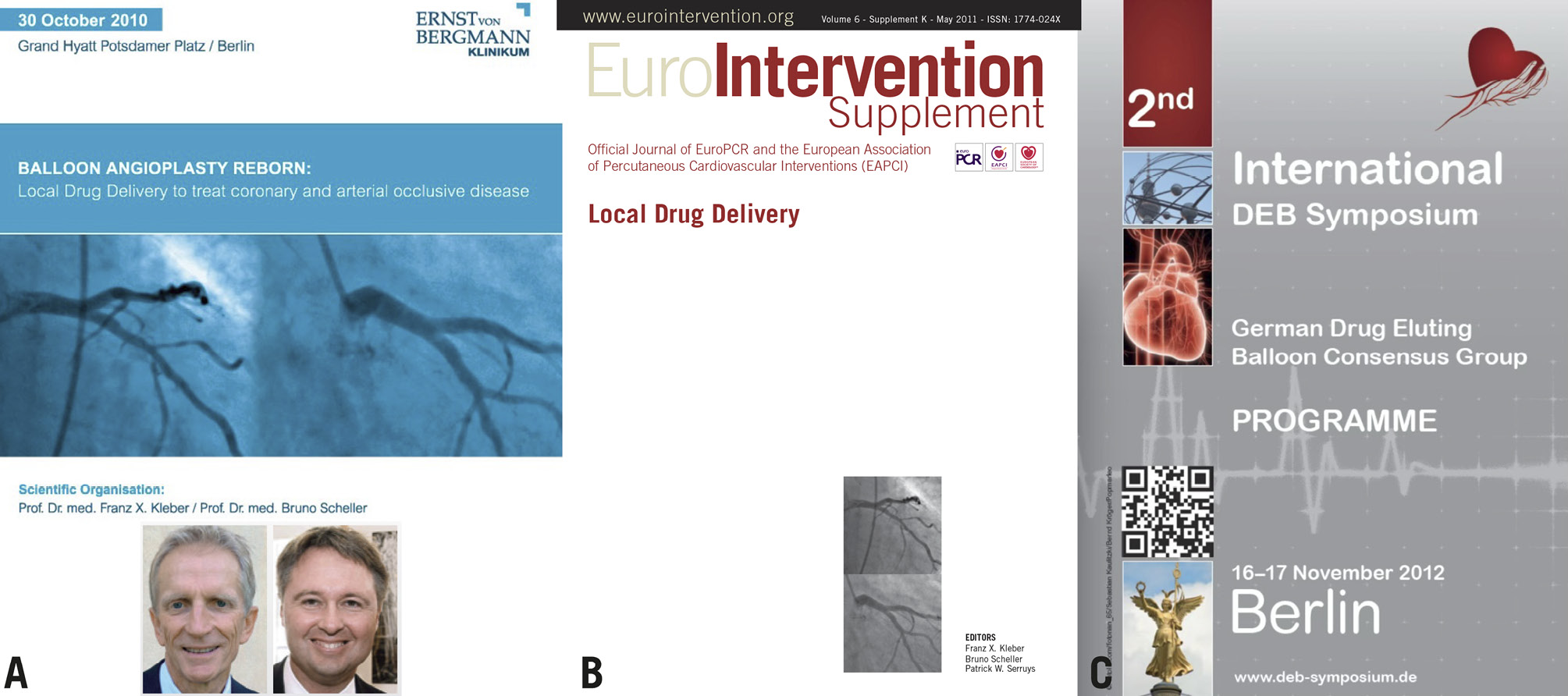
Figure 1. First DCB Consensus Meetings and publications introducing the concept of ‘DCB-only’. A) Flyer for the first DCB Berlin meeting in October 2010; (B) cover of the EuroIntervention Supplement 2011; (C) flyer from the second DCB Berlin meeting in November 2012. DCB: drug-coated balloon

Conflict of interest statement

B. Scheller is a shareholder of InnoRa GmbH; and received lecture fees and advisory board honoraria from B.Braun, Medtronic, and Cordis. F. X. Kleber reports no conflicts of interest related to this editorial.
Share

References

  • Scheller B, Hehrlein C, Bocksch W, Rutsch W, Haghi D, Dietz U, Böhm M, Speck U. Treatment of coronary in-stent restenosis with a paclitaxel-coated balloon catheter. N Engl J Med 2006;355:2113-24
  • King SB 3rd. A disruptive intervention. Cardiovasc Revasc Med 2025;81:164-5
  • Unverdorben M, Kleber FX, Heuer H, Figulla HR, Vallbracht C, Leschke M, Cremers B, Hardt S, Buerke M, Ackermann H, Boxberger M, Degenhardt R, Scheller B. Treatment of small coronary arteries with a paclitaxel-coated balloon catheter. Clin Res Cardiol 2010;99:165-74
  • Kleber FX, Scheller B, Serruys PW. New technologies in percutaneous coronary interventions: drug-coated balloons. EuroIntervention 2011;7 Suppl K:K7
  • Kleber FX, Mathey DG, Rittger H, Scheller B; German Drug-eluting Balloon Consensus Group. How to use the drug-eluting balloon: recommendations by the German consensus group. EuroIntervention 2011;7 Suppl K:K125-8
  • Jeger RV, Eccleshall S, Wan Ahmad WA, Ge J, Poerner TC, Shin ES, Alfonso F, Latib A, Ong PJ, Rissanen TT, Saucedo J, Scheller B, Kleber FX; International DCB Consensus Group. Drug-Coated Balloons for Coronary Artery Disease: Third Report of the International DCB Consensus Group. JACC Cardiovasc Interv 2020;13:1391-402
  • Fezzi S, Scheller B, Cortese B, Alfonso F, Jeger R, Colombo A, Joner M, Shin ES, Kleber FX, Latib A, Rissanen TT, Eccleshall S, Ribichini F, Tao L, Koo BK, Chieffo A, Ge J, Granada JF, Stoll HP, Spaulding C, Cavalcante R, Abizaid A, Muramatsu T, Boudoulas KD, Waksman R, Mehran R, Cutlip DE, Krucoff MW, Stone GW, Garg S, Onuma Y, Serruys PW. Definitions and standardized endpoints for the use of drug-coated balloon in coronary artery disease: consensus document of the Drug Coated Balloon Academic Research Consortium. EuroIntervention 2025;21:e1116-36
  • Fezzi S, Serruys PW, Cortese B, Scheller B, Alfonso F, Jeger R, Colombo A, Joner M, Shin ES, Kleber F, Latib A, Rissanen TT, Eccleshall S, Ribichini F, Tao L, Koo BK, Chieffo A, Ge J, Granada JF, Stoll HP, Spaulding C, Cavalcante R, Abizaid A, Muramatsu T, Boudoulas KD, Waksman R, Mehran R, Cutlip D, Krucoff M, Stone GW, Garg S, Onuma Y. Indications for Use of Drug-Coated Balloons in Coronary Intervention: Academic Research Consortium Position Statement. J Am Coll Cardiol 2025;86:1170-202
  • Alfonso F, Kleber FX, Scheller B; DCB Club. The Drug-Coated Balloon Club (DCB Club): meeting and mission statement Eur Heart J 2025;
  • Fezzi S, Gitto M, Trevisanello, A, Sharif F, Venturi G, Bezubka J, Iwanczyk S, Wanha W, Hawranek M, Mielczarek M, Wanczura P, Verdoia M, Pieri P, Mugnolo A, Khialani B, Litovchik I, Monayer A, Rissanen TT, Ribichini F, Colombo A, Cortese B. Angiographic and functional assessment after paclitaxel or sirolimus drug-coated balloons for de novo coronary artery disease in small vessels: PICCOLETO VI study AsiaIntervention 2026;12:28-40
  • Ahmad WAW, Nuruddin AA, Abdul Kader MASK, Ong TK, Liew HB, Ali RM, Mahmood Zuhdi AS, Ismail MD, Yusof AKM, Schwenke C, Kutschera M, Scheller B. Treatment of Coronary De Novo Lesions by a Sirolimus- or Paclitaxel-Coated Balloon JACC Cardiovasc Interv 2022;
  • Scheller B, Mangner N, Jeger RV, Afan S, Mahfoud F, Woitek FJ, Fahrni G, Schwenke C, Schnorr B, Kleber F. A randomised trial of sirolimus- versus paclitaxel-coated balloons for de novo coronary lesions. EuroIntervention 2024;20:e1322-9
  • Ninomiya K, Serruys PW, Colombo A, Reimers B, Basavarajaiah S, Sharif F, Testa L, Di Mario C, Nerla R, Ding D, Huang J, Kotoku N, Kageyama S, Kageyama M, Sevestre E, Fezzi S, Dijkstra J, O’Leary N, Morel MA, Garg S, Cortese B, Onuma Y. A Prospective Randomized Trial Comparing Sirolimus-Coated Balloon With Paclitaxel-Coated Balloon in De Novo Small Vessels. JACC Cardiovasc Interv 2023;16:2884-96
  • Rhee TM, Lee JM, Shin ES, Hwang D, Park J, Jeon KH, Kim HL, Yang HM, Han JK, Park KW, Hahn JY, Koo BK, Kim SH, Kim HS. Impact of Optimized Procedure-Related Factors in Drug-Eluting Balloon Angioplasty for Treatment of In-Stent Restenosis. JACC Cardiovasc Interv 2018;11:969-78
  • Huber MS, Mooney JF, Madison J, Mooney MR. Use of a morphologic classification to predict clinical outcome after dissection from coronary angioplasty. Am J Cardiol 1991;68:467-71
  • Corballis NH, Merinopoulos I, Natarajan R, Gunawardena T, Wickramarachchi U, Vassiliou VS, Colombo A, Scheller B, Eccleshall S. Safety aspects of de novo DCB-only PCI-a practical checklist and a simplified revised dissection classification. Front Cardiovasc Med 2025;12:1655201
  • Gao XF, Ge Z, Kong XQ, Chen X, Han L, Qian XS, Zuo GF, Wang ZM, Wang J, Song JX, Lin L, Pan T, Ye F, Wang Y, Zhang JJ, Chen SL; ULTIMATE III Investigators. Intravascular Ultrasound vs Angiography-Guided Drug-Coated Balloon Angioplasty: The ULTIMATE III Trial. JACC Cardiovasc Interv 2024;17:1519-28
  • De Luca G, Algowhary M, Uguz B, Oliveira DC, Ganyukov V, Zimbakov Z, Cercek M, Jensen LO, Loh PH, Calmac L, Roura I Ferrer G, Quadros A, Milewski M, D’Uccio FS, von Birgelen C, Versaci F, Berg JT, Casella G, Lung AWS, Kala P, Díez Gil JL, Carrillo X, Dirksen M, Becerra-Munoz VM, Lee MK, Juzar DA, Moura Joaquim R, Paladino R, Milicic D, Davlouros P, Bakraceski N, Zilio F, Donazzan L, Kraaijeveld A, Galasso G, Arpad L, Lucia M, Vincenzo G, Menichelli M, Scoccia A, Yamac AH, Mert KU, Rios XF, Kovarnik T, Kidawa M, Moreu J, Flavien V, Fabris E, Martínez-Luengas IL, Ojeda FB, Rodríguez-Sanchez R, Caiazzo G, Cirrincione G, Kao HL, Forés JS, Vignali L, Pereira H, Manzo S, Ordoñez S, Özkan AA, Scheller B, Lehtola H, Teles R, Mantis C, Antti Y, Silveira JAB, Zoni R, Bessonov I, Savonitto S, Kochiadakis G, Alexopulos D, Uribe CE, Kanakakis J, Faurie B, Gabrielli G, Gutierrez Barrios A, Bachini JP, Rocha A, Tam FC, Rodriguez A, Lukito AA, Bellemain-Appaix A, Pessah G, Cortese G, Parodi G, Burgadha MA, Kedhi E, Lamelas P, Suryapranata H, Nardin M, Verdoia M. Impact of diabetes on epicardial reperfusion and mortality in a contemporary STEMI population undergoing mechanical reperfusion: Insights from the ISACS STEMI COVID 19 registry. Nutr Metab Cardiovasc Dis 2025;35:103763
  • Shin ES, Ann SH, Balbir Singh G, Lim KH, Kleber FX, Koo BK. Fractional flow reserve-guided paclitaxel-coated balloon treatment for de novo coronary lesions. Catheter Cardiovasc Interv 2016;88:193-200
  • Kleber FX, Schulz A, Waliszewski M, Hauschild T, Böhm M, Dietz U, Cremers B, Scheller B, Clever YP. Local paclitaxel induces late lumen enlargement in coronary arteries after balloon angioplasty. Clin Res Cardiol 2015;104:217-25
  • Kawai T, Watanabe T, Yamada T, Morita T, Furukawa Y, Tamaki S, Kawasaki M, Kikuchi A, Seo M, Nakamura J, Tachibana K, Kida H, Sotomi Y, Sakata Y, Fukunami M. Coronary vasomotion after treatment with drug-coated balloons or drug-eluting stents: a prospective, open-label, single-centre randomised trial. EuroIntervention 2022;18:e140-8

Volume 12 - Number 1

View full issue

Download this article
Authors
  • Bruno Scheller
  • Franz X. Kleber
AsiaIntervention - 10 Years
  • Readers
    • Archives
    • Subscribe to the newsletter
    • Contact us
  • About the journal
    • Overview
    • Editorial Board
    • Masthead
  • Services
    • Advertising in AsiaIntervention
    • Article reprints
    • Publication calendar
    • Rights & Permissions
  • Authors
    • Authors guidelines
    • Submit your paper
  • Legal
    • Disclaimer
    • Cookies Policy
    • Privacy Policy
    • Legal Notice
  • Follow us
    • Facebook
    • X
    • LinkedIn
Online ISSN 2491-0929 - Print ISSN 2426-3958
© 2015-2026 Europa Group - All rights reserved