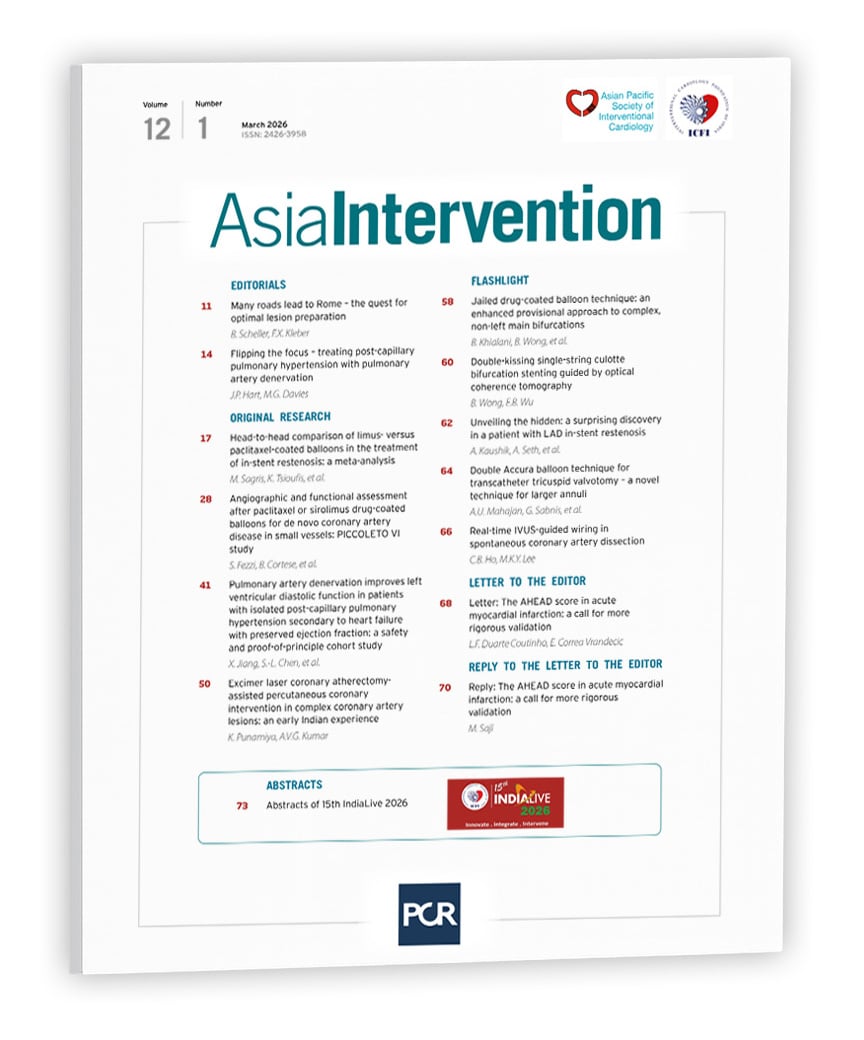
I wish all our readers a very happy new year for 2026. This year’s first issue is being launched at the 14th India Live on 19 March, in the historic city of Delhi, the capital city of India. India Live is a well-known, premier, annual interventional cardiology course, which, over the years, has become a very influential platform for showing cutting-edge technology and practice in cardiology. This issue also includes selected scientific abstracts that are being presented at the meeting.
The issue has two articles on drug-coated balloons (DCBs). DCBs are a key tool in cardiology, primarily for treating in-stent restenosis in coronary arteries, offering a stentless option to prevent cell growth without leaving metal behind. Paclitaxel, a lipophilic drug, has been used for percutaneous coronary intervention (PCI) since 2004. Subsequently, sirolimus analogues entered clinical practice, following the development of effective delivery systems around 2010. A lingering question remains: are these two drugs equivalent? In this issue, Marios Sagris, Konstantinos Tsioufis et al present a meta-analysis of studies using paclitaxel and sirolimus DCBs. Both were found to be comparable in outcomes, including the observed major adverse cardiovascular events, all-cause mortality, cardiac death, or target vessel myocardial infarction. Likewise, the angiographically studied parameters were similar. However, while the prospective PICCOLETO VI study reported by Simone Fezzi, Bernardo Cortese et al demonstrated equivalence in clinical outcomes and late functional loss, it nonetheless showed superior results in the angiographic outcomes with paclitaxel DCB, which included lower late loss and better lumen enlargement. In their accompanying editorial, Bruno Scheller and Franz Kleber commend the study, which showed a similar clinical response with both drugs despite better angiographic outcomes with paclitaxel. They caution that DCB results are subject to dynamic changes due to late lumen enlargement or vessel shrinkage and the return of vasomotion, meaning, therefore, that geometric and physiological parameters measured at rest may vary during exercise. This challenge potentially influences clinical outcomes and merits a dedicated prospective study.
Another interesting article in this issue is on the role of pulmonary arterial denervation in the treatment of heart failure with preserved ejection fraction (HFpEF) by Xiaomin Jiang, Shao-Liang Chen et al. The authors report a significant clinical improvement, as demonstrated by the 6-minute walk distance test. This was accompanied by significant reductions in pulmonary arterial pressure and pulmonary artery wedge pressure, likely driven by improved left ventricular relaxation, as reflected by the minimum rate of change of ventricular pressure in these sick patients with isolated post-capillary pulmonary hypertension (IpcPH) associated with HFpEF, which until recently defied treatment. Whether this would complement the benefits provided by sodium-glucose cotransporter-2 inhibitors, finerenone, and glucagon-like peptide-1 analogues, as shown in recent studies, remains to be seen. HFpEF leading to IpcPH is a distinct entity. Joseph P. Hart and Mark G. Davies, commenting on this study, have lauded the effort by the authors but also pointed out the limitations − including a very short period of evaluation, a limited sample size, and a non-normal data distribution − restricting its generalisability. It is thus a hypothesis-generating concept needing longer-term randomised studies.
Excimer laser use during PCI for complex procedures including chronic total occlusions (CTOs) has been in clinical practice since the 1980s; however, the adoption of this technique in our region has been very slow because of the evolution of competing devices, fear of complications, and a lack of experience. In this issue, Kirti Punamiya and Ganesh Kumar describe their experience with very complex cases, including CTOs and heavily calcified lesions, in 71 patients. The success rate was 100% with minimal major adverse cardiac events − very commendable results indeed.
There are five interesting Flashlights in this issue: three on coronary interventions − two demonstrate the utility of intravascular imaging during procedures where angiography alone was deceptive − and another focuses on three-dimensional optical coherence tomography-guided single-string culotte. The fourth Flashlight describes successful use of a jailed DCB technique in bifurcation PCI and the last Flashlight is on the double Accura balloon technique for transcatheter tricuspid valvotomy, used as a novel palliative procedure for larger annuli.
The issue ends with a letter to the Editor from Luis Felipe Duarte Coutinho and Erika Correa Vrandecic, commenting on the article regarding the AHEAD score in acute myocardial infarction, published in the previous issue of this Journal, and pointing out the methodological flaws. The original lead author, Mike Saji responds and reiterates their views.
I do hope you find the issue intellectually stimulating. Feedback is always welcome to improve the quality of our Journal.
Happy reading,
Upendra Kaul, Editor-in-Chief